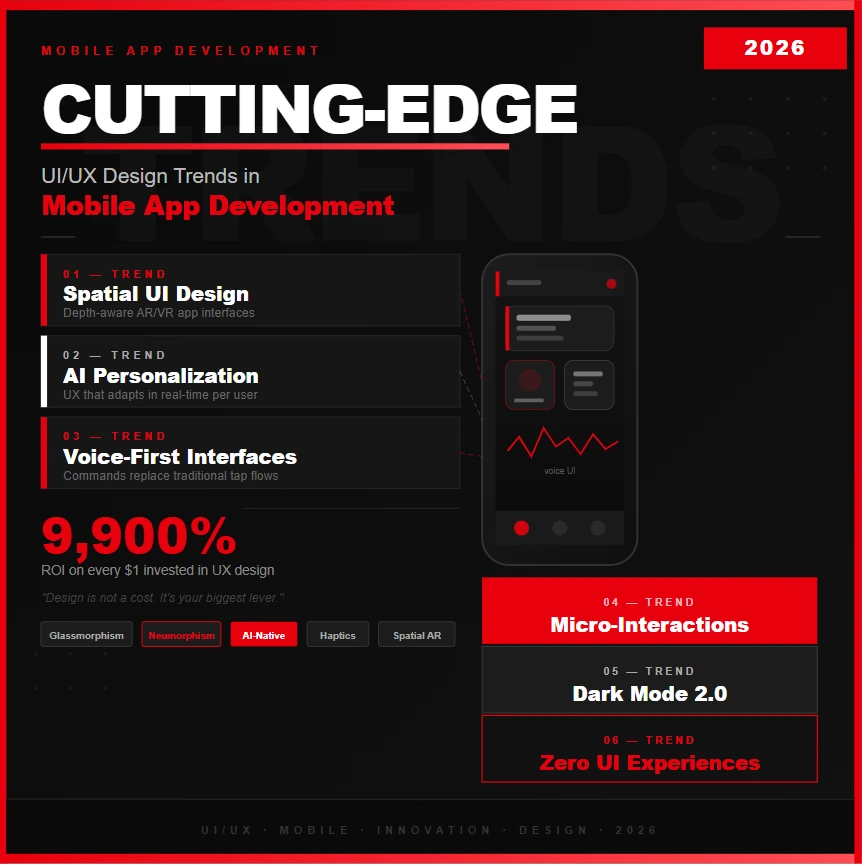
Mastering UI/UX design trends in 2026 requires moving beyond flat aesthetics into immersive, intelligence-driven experiences. The era of static, “one-size-fits-all” interfaces is officially over. In a market where users expect their devices to anticipate their needs and respect their digital carbon footprint, staying relevant means architecting apps that feel less like tools and more like intuitive extensions of the human experience. If your app still relies on 2022 navigation patterns, you aren’t just behind; you’re invisible.
The Post-Screen Era: Why 2026 is Different
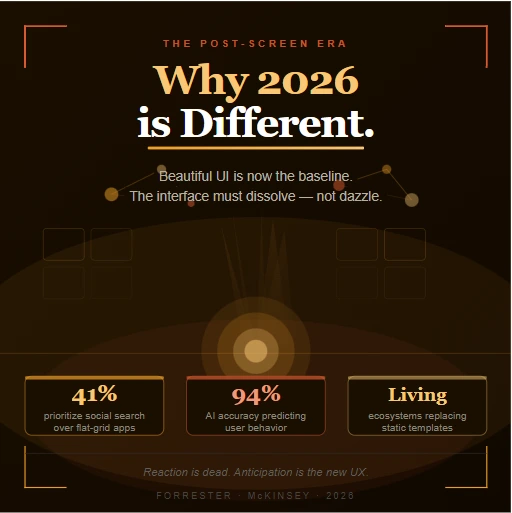
The frustration of launching a mobile app that feels like a relic of the past is a common pitfall for brands that chase aesthetics over intelligence. In 2026, a “beautiful” UI is the baseline, not the goal. The real value lies in how the interface dissolves into the background to facilitate the user’s objective.
Data reveals that 41% of decision-makers now prioritize “social search” and immersive interfaces over traditional flat-grid apps. Furthermore, AI-driven predictive models can now anticipate user behavior with up to 94% accuracy, shifting the focus from reaction to anticipation.
We are entering a stage where static templates are dying. They are being replaced by living, breathing digital ecosystems that adapt to the user’s environment, mood, and physical capabilities.
Businesses planning to develop mobile apps in the future need to know how to assess the team that is working on developing those innovative apps. Read more about how you can find the right UI/UX design agency for your mobile application development in our in-depth guide on the subject.
10 Revolutionary UI/UX Design Trends (2026)
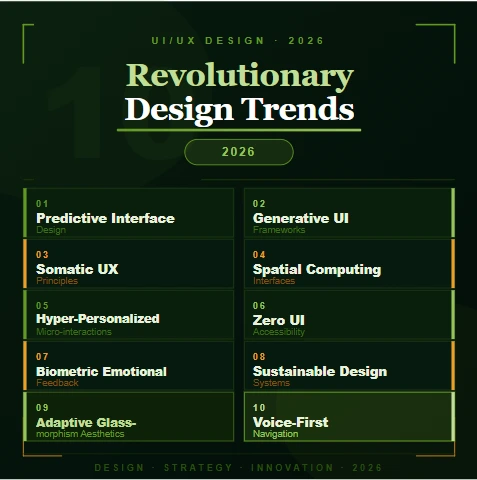
1. Predictive Interface Design
Why wait for a user to find a button when the app can surface it exactly when it’s needed? Predictive interface design uses machine learning to analyze past behavior and current context to simplify the screen. If the button isn’t there before they even realize they want it, the UX has already failed the modern intelligence test.
2. Generative UI Frameworks
No two users should ever see the same layout. Generative UI frameworks allow an interface to rebuild its own code in real-time. Whether a user is a beginner who needs simplified tools or a power user who requires a dense dashboard, the UI adapts its structure, density, and flow to match their specific intent and skill level.
3. Somatic UX Principles
We are designing for the body, not just the eyes. Somatic UX principles prioritize the “muscle memory” of the hand. By focusing on “haptic thumb-zones” and movement-based feedback, we create interactions that feel physically natural. It’s about how the phone rests in the hand and how vibration patterns confirm a task without the user needing to look at the screen.
4. Spatial Computing Interfaces
With the democratization of mixed-reality hardware, spatial computing interfaces are breaking the 2D plane. Designing for the Z-axis means creating depth, layers, and “anchored” elements that exist in the user’s physical space. This trend bridges the gap between the digital and the physical, allowing for 3D navigation that feels like an expansion of reality.
5. Hyper Personalized Micro-interactions
The “little things” now have big intelligence. Hyper personalized microinteractions recognize the individual user, like a loading bar that adjusts its speed based on your historical patience or buttons that change color based on the time of day and ambient room light. These tiny details build a deep sense of personal connection.
6. Zero UI Accessibility
True inclusion means designing for the moments when a user cannot look at a screen. Zero UI accessibility leverages haptics, bone conduction, and advanced voice cues. By moving away from purely visual feedback, we make apps usable for everyone, including those with visual impairments or those in situations where their hands and eyes are busy.
7. Biometric Emotional Feedback
Modern apps are becoming emotionally intelligent. By utilizing biometric emotional feedback (tracking subtle signals like heart rate or facial micro-expressions), an app can detect user frustration. If the system senses a user is struggling with a form, it can automatically simplify the UI or offer a supportive chat prompt to reduce stress.
8. Sustainable Design Systems
Eco-friendly design is no longer an option; it’s a strategic advantage. Sustainable design systems focus on reducing the “digital carbon footprint” by optimizing asset weights and dark-mode energy consumption. Every millisecond saved in loading and every pixel not unnecessarily lit contributes to a greener digital ecosystem and faster performance.
9. Adaptive Glassmorphism Aesthetics
The evolution of “frosted glass” has arrived. Adaptive glassmorphism aesthetics use dynamic transparency that blurs and shifts in real-time based on the ambient light of the user’s physical room. This creates a sense of depth and realism that makes digital elements feel like they are physically present in the user’s environment.
10. Voice-First Navigation
We are moving from “tap and scroll” to “ask and receive.” Voice-first navigation isn’t just a gimmick; it’s a primary method for handling complex, multi-step tasks. By designing conversational flows that understand context and nuance, we eliminate the need for deep menu diving, making navigation entirely hands-free.
The FlowmazeUX Vision: Architecting the Future
Investing in specialized 2026 UX trends isn’t just about looking modern; every $1 invested in superior UX design returns up to $100 in value. At FlowmazeUX, we don’t just follow UI/UX design trends; we build the case studies that define them. Our team focuses on solving real-world problems by integrating these 2026 trends into e-commerce, SaaS, and mobile products. As we know, a trend is only valuable if it drives results.