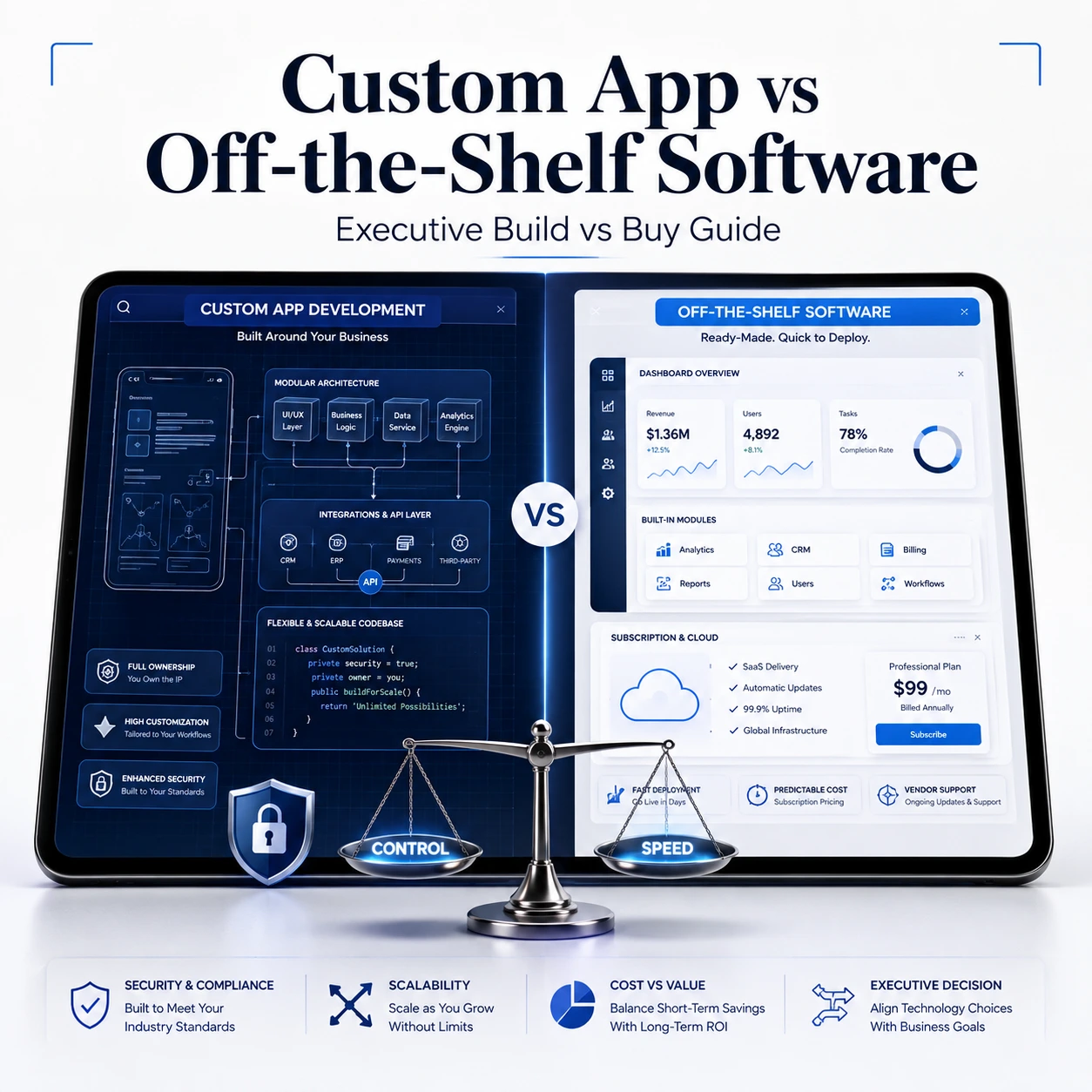
Choosing between a custom app and off-the-shelf software can have a lasting impact on cost, flexibility, and day-to-day operations. Custom development gives businesses more control over features, workflows, and intellectual property. Off-the-shelf software is usually quicker to deploy, costs less upfront, and comes with vendor-managed support and infrastructure.
This trade-off requires direct analysis of technical debt, scaling limits, total operational costs, and core competitive advantages. Deploying an ill-fitted commercial platform forces business processes to contort around rigid software frameworks.
Conversely, building custom applications without disciplined scoping introduces delivery delays and budget overruns. This executive guide breaks down essential architectural criteria, financial calculations, and decision matrices to establish the optimal technology path for your business.
Strategic Control and Asset Ownership
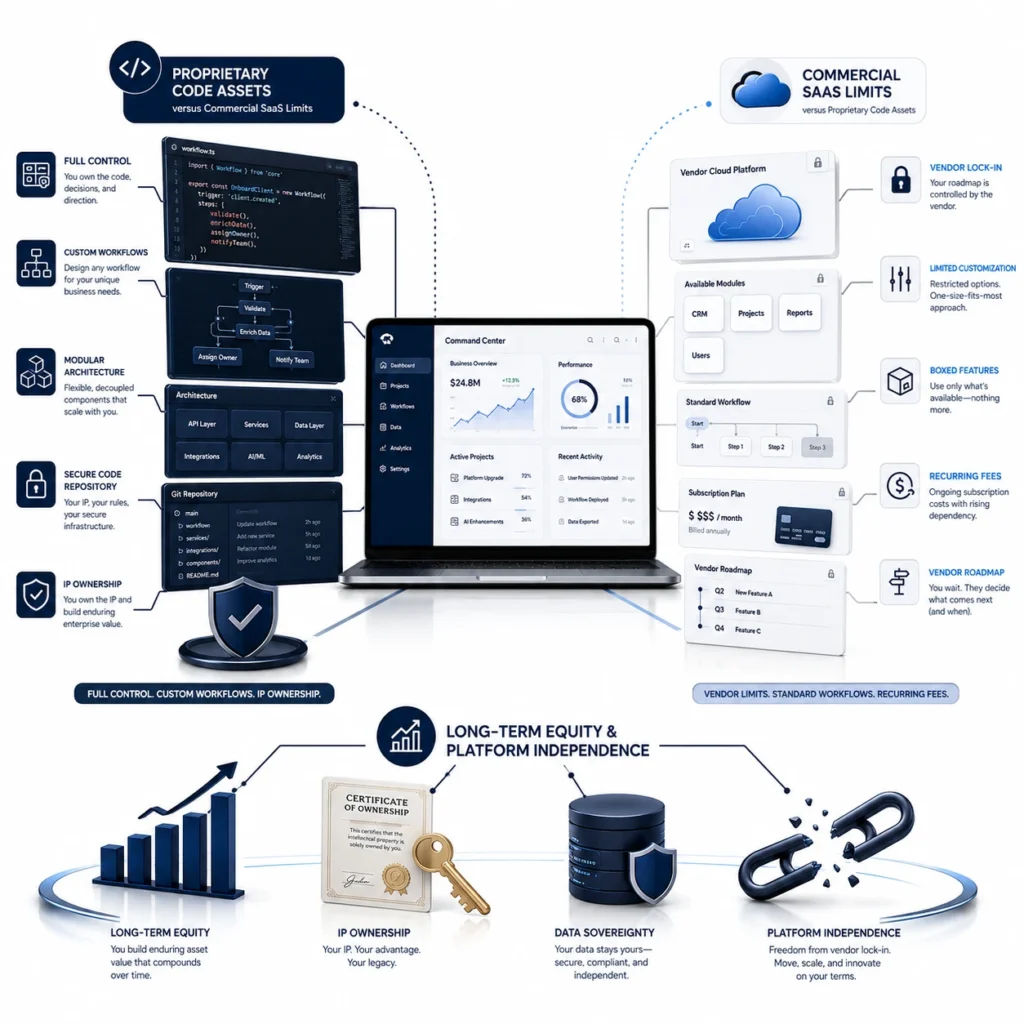
The structural gap between bespoke software builds and commercial off-the-shelf platforms dictates how an enterprise controls its digital future. Direct code ownership grants total operational flexibility, whereas subscription platforms delegate software roadmaps to third-party providers.
Proprietary Code Assets versus Commercial SaaS Limits
Bespoke software builds a customized digital ecosystem aligned directly with internal business operations. Off-the-shelf Software-as-a-Service platforms force organizations to alter internal workflows to fit standardized, out-of-the-box feature sets. While commercial platforms accelerate initial account creation, they restrict operational flexibility when unique requirements emerge.
Deploying a customized application strategy allows growing teams to construct proprietary user interfaces, bespoke data models, and unique automation rules that protect core competitive advantages.
Long Term Equity and Platform Independence
Securing a proprietary enterprise software asset converts routine technology expenditures from an ongoing operating expense into balance sheet equity. Recurring subscription fees create continuous financial drain without building tangible asset value. Building a proprietary application secures complete authority over codebase evolution, data sovereignty, and system architecture. This asset ownership raises company valuation during corporate transactions while eliminating third-party vendor shutdown risks.
Total Cost Analysis and Five-Year Financial Math
Choosing between a custom app vs off-the-shelf software can have a lasting impact on cost, flexibility, and day-to-day operations. Custom development gives businesses more control over features, workflows, and intellectual property. Off-the-shelf software is usually quicker to deploy, costs less upfront, and comes with vendor-managed support and infrastructure.
Lifetime Math via Total Cost of Ownership Software Calculation
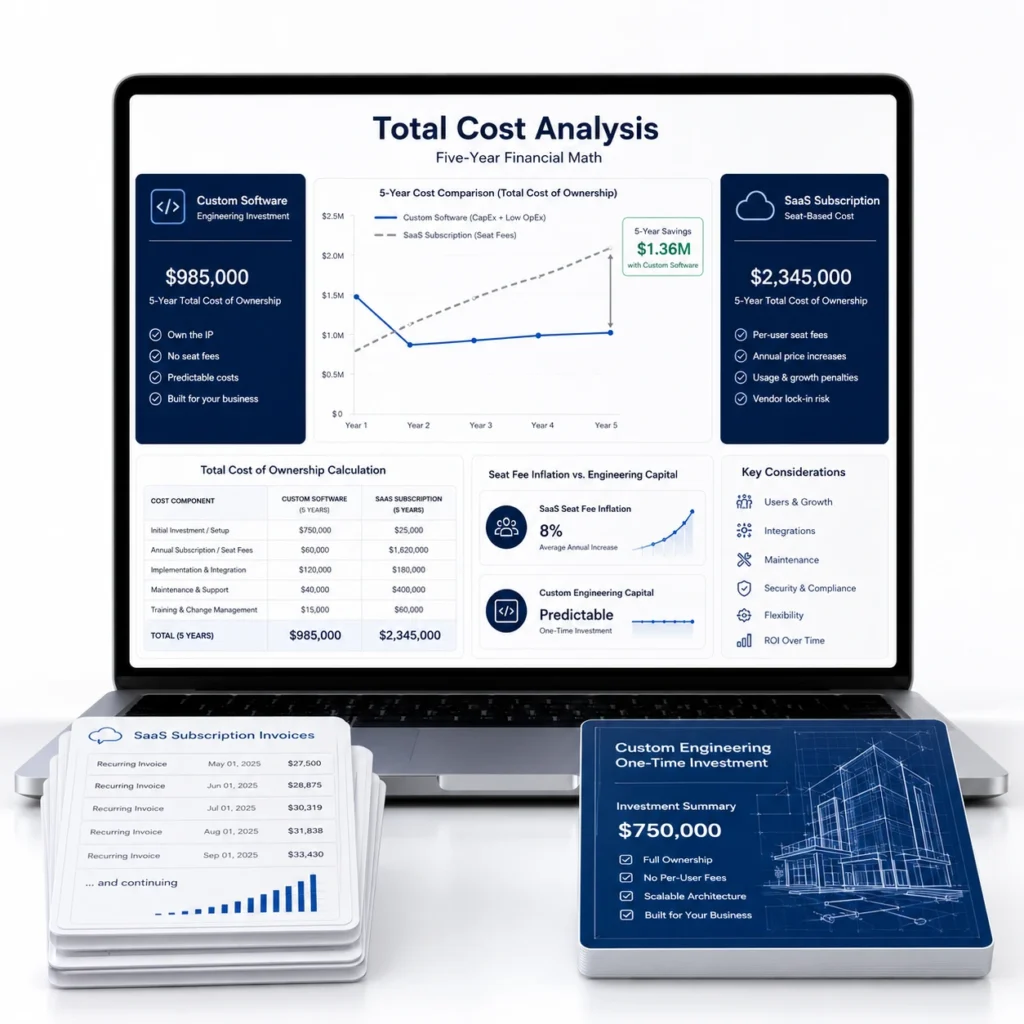
Executing an accurate total cost of ownership software calculation needs factoring in license escalation, custom integrations, cloud hosting, and continuous platform maintenance. Over a five-year horizon, seat-based SaaS subscriptions regularly surpass the total capital cost of building custom software. Use this mathematical formula to evaluate lifetime expenses:
Where (n) represents the operational lifecycle in years, (r) indicates the discount rate, and OpExt accounts for hosting infrastructure and platform administration.
Seat Fee Inflation versus Custom Engineering Capital
Standard commercial off-the-shelf software platforms charge recurring fees that scale with headcount. As your enterprise hires more staff, subscription overhead rises exponentially. Custom software development shifts financial models toward predictable cloud hosting expenses, allowing team size to double without increasing software access fees.
Deployment Velocity and Integration Ecosystems
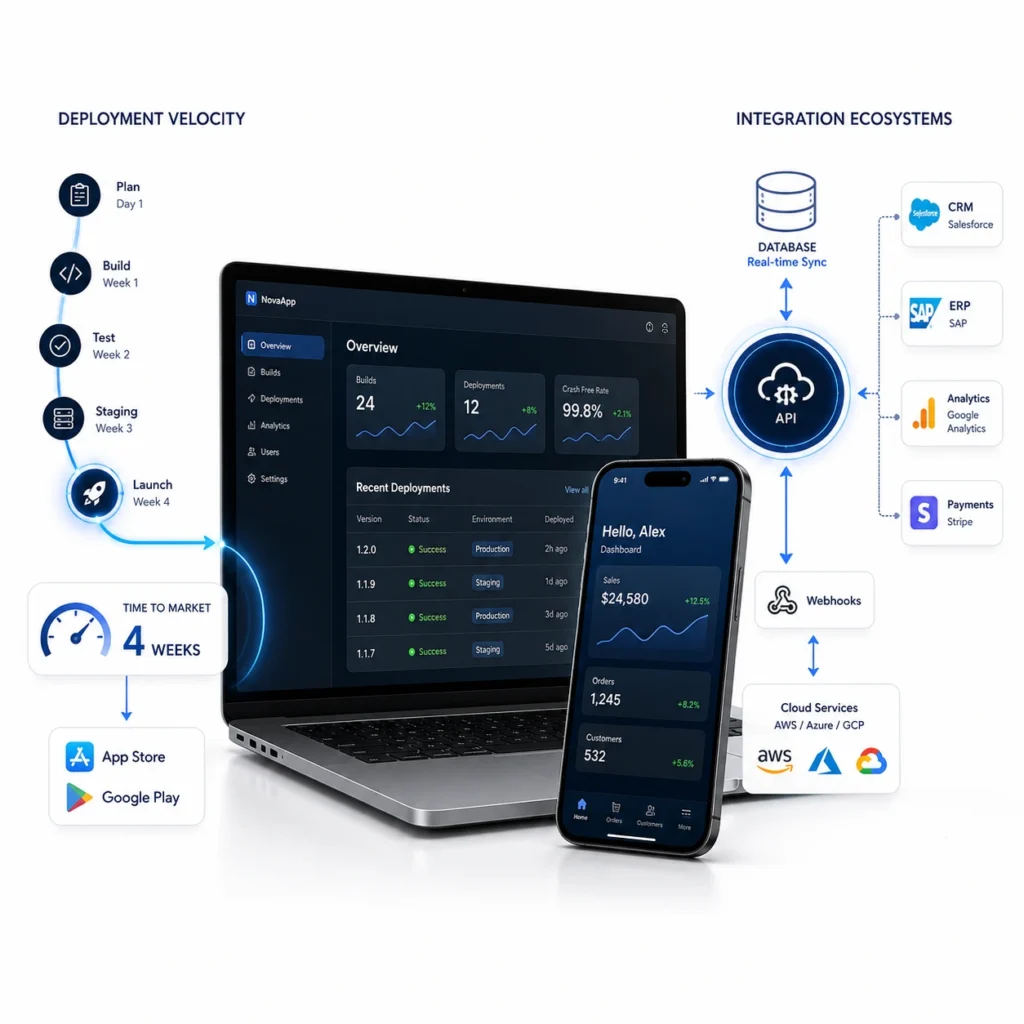
Market velocity and ecosystem connectivity drive competitive separation in digital industries. Balancing rapid delivery needs against deep systemic integration requirements dictates software selection.
Rapid Launch Timelines via App Deployment Time to Market
Commercial off-the-shelf software offers rapid app deployment time to market, enabling instant account setup and basic tool activation. Organizations requiring functional software within days benefit from commercial platforms. Conversely, bespoke mobile application development cycles require structured discovery, UI/UX design architecture, sprint development, and rigorous quality assurance, extending rollout timelines across several months.
Direct Database Sync through Custom API Integration Capabilities
Bespoke software delivers limitless custom API integration capabilities, connecting directly with legacy ERPs, CRMs, and internal databases. Out-of-the-box software relies on pre-built connectors or restricted public APIs, frequently creating data silos across internal departments. Custom software development allows engineers to architect direct database connectors, real-time webhooks, and optimized middleware, providing fluid data movement across all enterprise systems.
System Governance and Regulatory Security
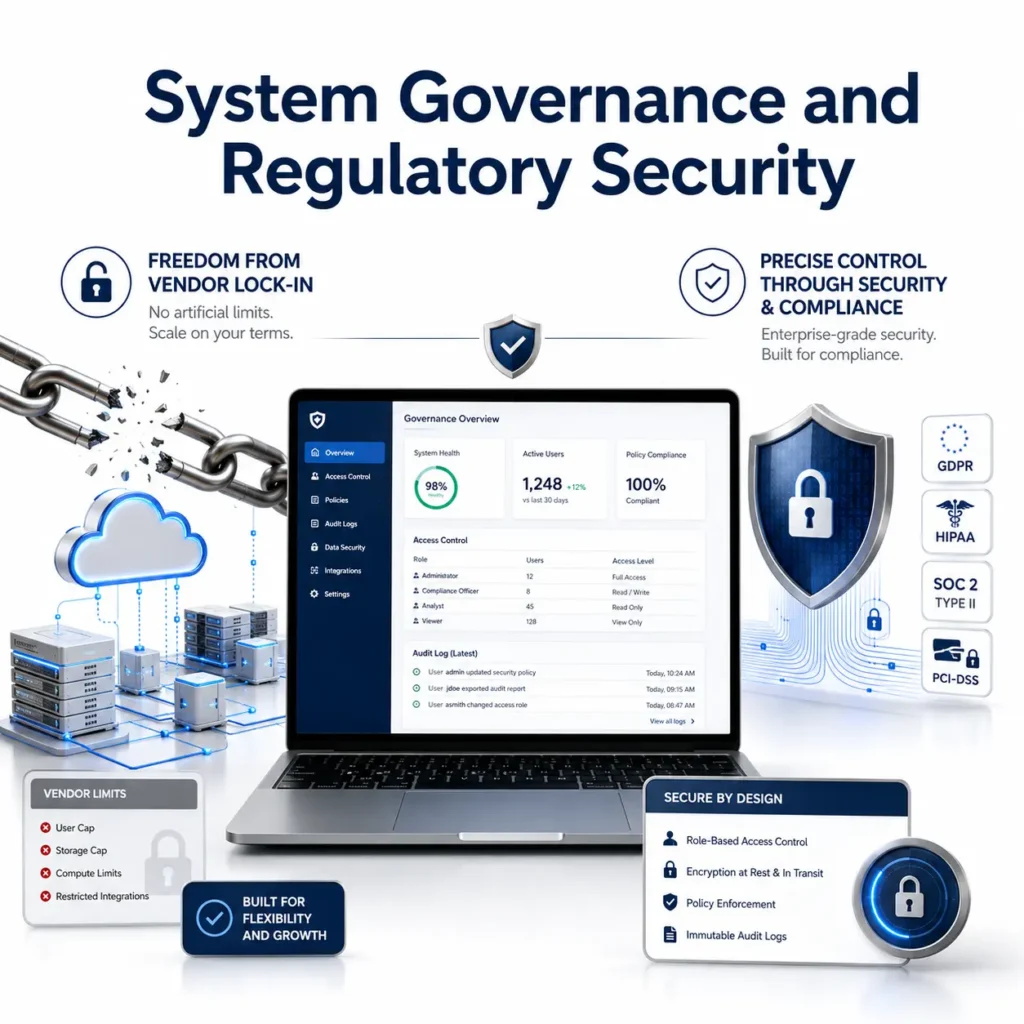
Long-term software viability depends on system scalability, regulatory compliance, and freedom from vendor-imposed constraints. Evaluating governance frameworks prevents operational friction as user activity expands.
Freedom from Vendor Lock-in and Artificial Scale Caps
Custom applications provide complete architectural freedom, eliminating software scalability bottlenecks and vendor lock-in. Proprietary software subscriptions expose enterprises to sudden pricing tier changes, forced feature deprecations, and mandatory platform migrations. Building custom applications keeps database sharding, microservices architecture, and cloud infrastructure directly in your hands, allowing platforms to scale without unexpected cost spikes.
Precise Control via Enterprise Software Security and Compliance
Developing custom enterprise software delivers precise compliance with stringent industry standards like HIPAA, GDPR, SOC 2, and PCI-DSS. While commercial SaaS providers offer standardized security protocols, they rarely accommodate custom data retention rules or isolated physical servers. Custom applications grant complete control over encryption keys, role-based access control, audit logging, and local data residency requirements.
Custom App vs Off-the-Shelf Software: Strategic Decision Matrix
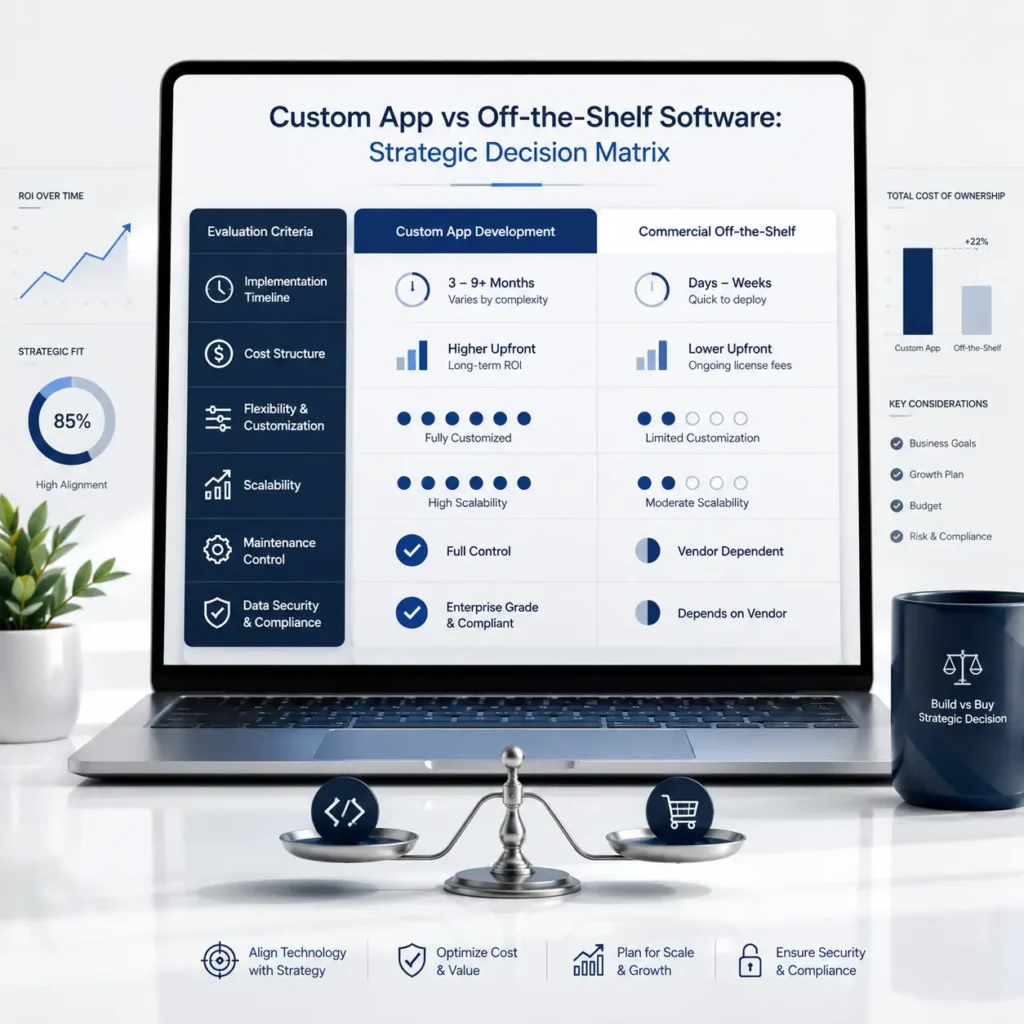
A clear decision matrix helps leadership teams compare both options against actual business needs rather than relying on initial price alone. The framework below looks at ownership, implementation time, scalability, flexibility, security, and long-term cost.
| Strategic Evaluation Criteria | Custom App Development | Commercial Off-the-Shelf |
| Primary Advantage | Complete IP ownership & tailored workflows | Rapid deployment & low upfront cost |
| Implementation Timeline | 3 to 9 Months | 1 to 4 Weeks |
| 5-Year Cost Structure | High initial CapEx; low ongoing OpEx | Low initial CapEx; compounding per-seat OpEx |
| System Flexibility | Unlimited customization & bespoke APIs | Restricted to vendor feature roadmap |
| Scalability Potential | High – Independent architecture control | Medium – Constrained by subscription tiers |
| Maintenance Control | Managed internally or via dev partner | Managed entirely by SaaS vendor |
| Data Security & Control | Full data sovereignty & custom RBAC | Shared cloud multi-tenant architecture |
FlowmazeUX: Product Design Engineering for High Growth SaaS
Building bespoke software or scaling complex enterprise dashboards demands intuitive interfaces, fluid user journeys, and robust visual design systems. FlowmazeUX engineers B2B SaaS dashboards, mobile applications, and enterprise web platforms that simplify multi-role access, optimize data visualization, and accelerate time-to-value for end users. Stop letting clunky interface design stall your software adoption. Partner with FlowmazeUX to elevate your product UX, boost user engagement, and convert software complexity into a clean, modern digital asset today.
Frequently Ask Questions
A custom app is custom-engineered to match the exact workflow requirements and data architecture of a specific organization. Off-the-shelf software is a standardized, mass-market platform built for general usage, requiring businesses to adjust internal operations to fit pre-existing feature sets.
Custom development grants the purchasing organization 100% ownership of the source code, intellectual property, and underlying database architecture. This total asset ownership allows businesses to modify, scale, host, or transfer their software platform without relying on third-party vendor roadmaps or subscription tiers.
Commercial off-the-shelf software makes financial sense when core operational requirements align with standard market processes, such as basic accounting or general email marketing. If the software function offers no unique competitive differentiation, buying a standardized subscription saves time and upfront capital.
An accurate calculation must include initial development costs, per-seat licensing fees, cloud hosting infrastructure, ongoing maintenance, custom API integration expenses, employee onboarding training, and potential productivity dips during system migration phases across a multi-year timeline.
Custom applications feature bespoke API endpoints built directly for your enterprise tech stack. Commercial SaaS platforms restrict integrations to pre-built native connectors or rate-limited public APIs, which often prevents real-time data sync across enterprise databases.
Bespoke mobile application development allows developers to implement custom security protocols, physical data isolation, specialized encryption standards, and granular role-based access control. This level of technical customization delivers direct compliance with strict regulatory frameworks like HIPAA, SOC 2, and GDPR.
Commercial off-the-shelf software deploys within days to weeks because the core product is already built and hosted. Custom enterprise software development typically requires three to nine months to complete product discovery, UX design, agile development sprints, security testing, and final deployment.
Developing proprietary software converts technology expenses into balance sheet equity and exclusive intellectual property. This exclusive digital asset raises overall company valuation, attracts potential investors, and creates a defensible competitive moat during strategic corporate evaluations.