Table of Content
Introduction
Choosing between building an internal design team and hiring an external studio is a critical decision for product owners. Making the wrong choice can stall your product roadmap and drain capital. When evaluating the merits of an In-House vs Agency structure, companies often fall into the trap of looking only at surface-level costs. They fail to account for the deep operational realities that dictate product success. Mobile product design is a highly specialized discipline. The way you structure your team will directly determine your product’s speed, quality, and market viability.
When companies are contrasting their internal staff members with external collaborators, they start by looking at the Best UI/UX Design Agency for Mobile App Development (Your 2026 Guide) before adopting any product development strategy.
The Core Trade-offs: Domain Deep-Dives vs. Cross-Industry Speed
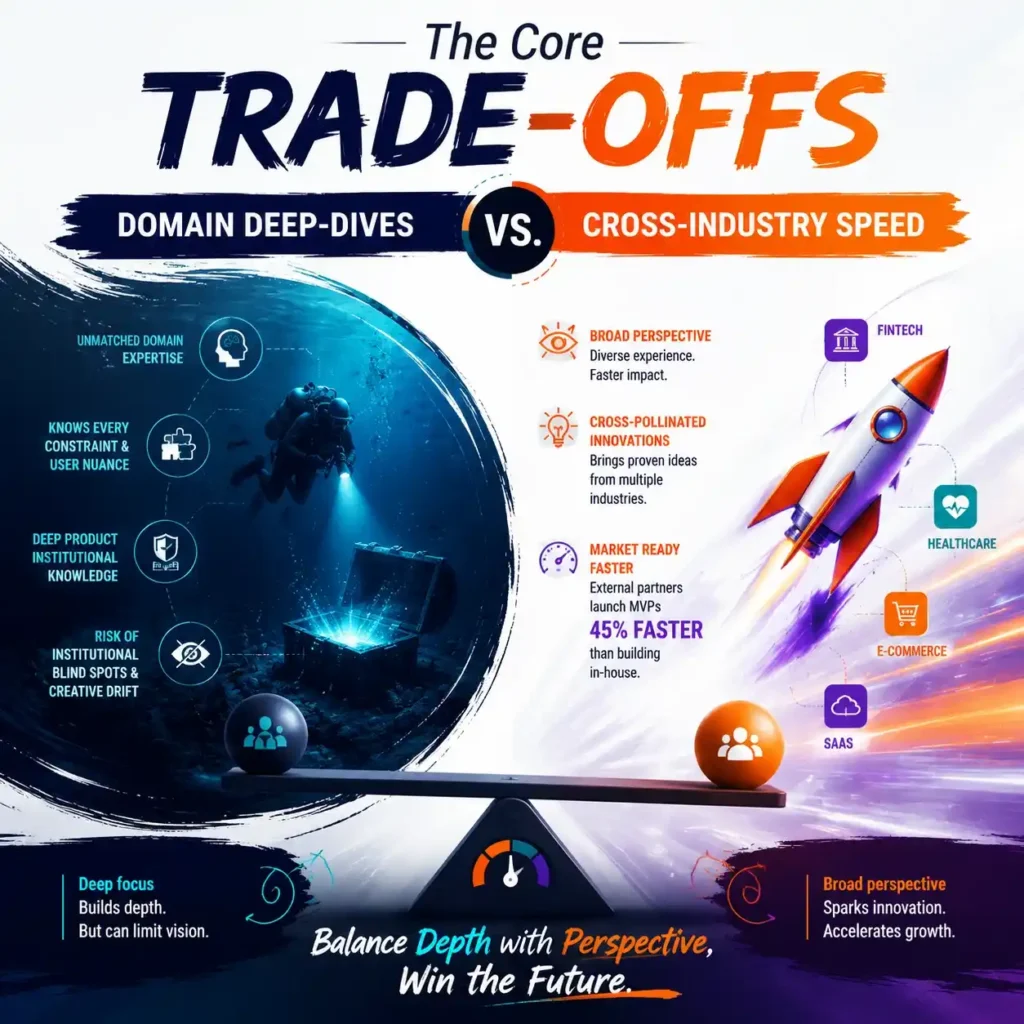
The foundational debate in the In-House vs Agency dilemma centers on focus versus perspective. An internal team offers deep, singular concentration, while a specialized agency provides rapid, broad-market insights.
When a corporate team lives inside a single software ecosystem for years, they develop unparalleled product domain expertise. They understand every legacy constraint, every user sub-segment, and the long-term vision of the company. However, this deep focus can easily turn into an operational blind spot. Internal teams often become institutionalized. They accept clunky user workflows and outdated interface patterns simply because “that is how we have always done it.” Research confirms this creative drift is one of the most common hidden costs of in-house design.
Companies utilizing external design partners launch their minimum viable products to market 45% faster than brands attempting to build internal hiring pipelines from scratch. This stagnation is where the external perspective value of an elite agency becomes a competitive advantage. Because agencies work across diverse industries, such as fintech, healthcare, and e-commerce, they cross-pollinate design innovations. They bring fresh, battle-tested solutions to stagnant product categories.
Explaining the Operational Friction: In-House vs Agency Realities
Operational efficiency is built on maintaining momentum. Every day your design team spends stuck in administrative loops is a day your competitors use to capture your target audience.
How to Solve Development Velocity Friction in Product Sprints?
A frequent symptom of an unstructured design process is development velocity friction. This bottleneck occurs when design assets are delivered late, poorly documented, or misaligned with engineering capabilities. In an In-House vs Agency comparison, internal teams often fall victim to shifting corporate priorities, endless internal review meetings, and office politics. These distractions slow down the delivery of critical design assets to the engineering team, delaying product launches.
Selecting the appropriate mobile application development design agency from the start will help avoid delays in your workflow and improve sprint completion.
Product Sprint Velocity Comparison
| Pipeline Type | Stages |
| In-House | [Hiring Wall] -> [Admin Loops] -> [Delayed Sprint] |
| Agency | [Onboard] -> [Direct Audit] -> [Active Sprint] |
Managing Cross Functional Alignment
Agencies solve velocity issues by operating under strict, milestone-driven contracts. They do not get pulled into unrelated internal company meetings. This focus enables them to maintain rapid production schedules.
However, external teams must work intentionally to establish strong cross functional alignment. If an agency works in total isolation without collaborating with its internal engineering leads, they risk designing beautiful interfaces that are technically impossible or overly expensive to code. True product velocity requires an agency that integrates directly into your technical pipeline, confirming that every wireframe aligns perfectly with your developers’ sprint capacities.
The Financial Ledger: Talent Overhead and Scalability
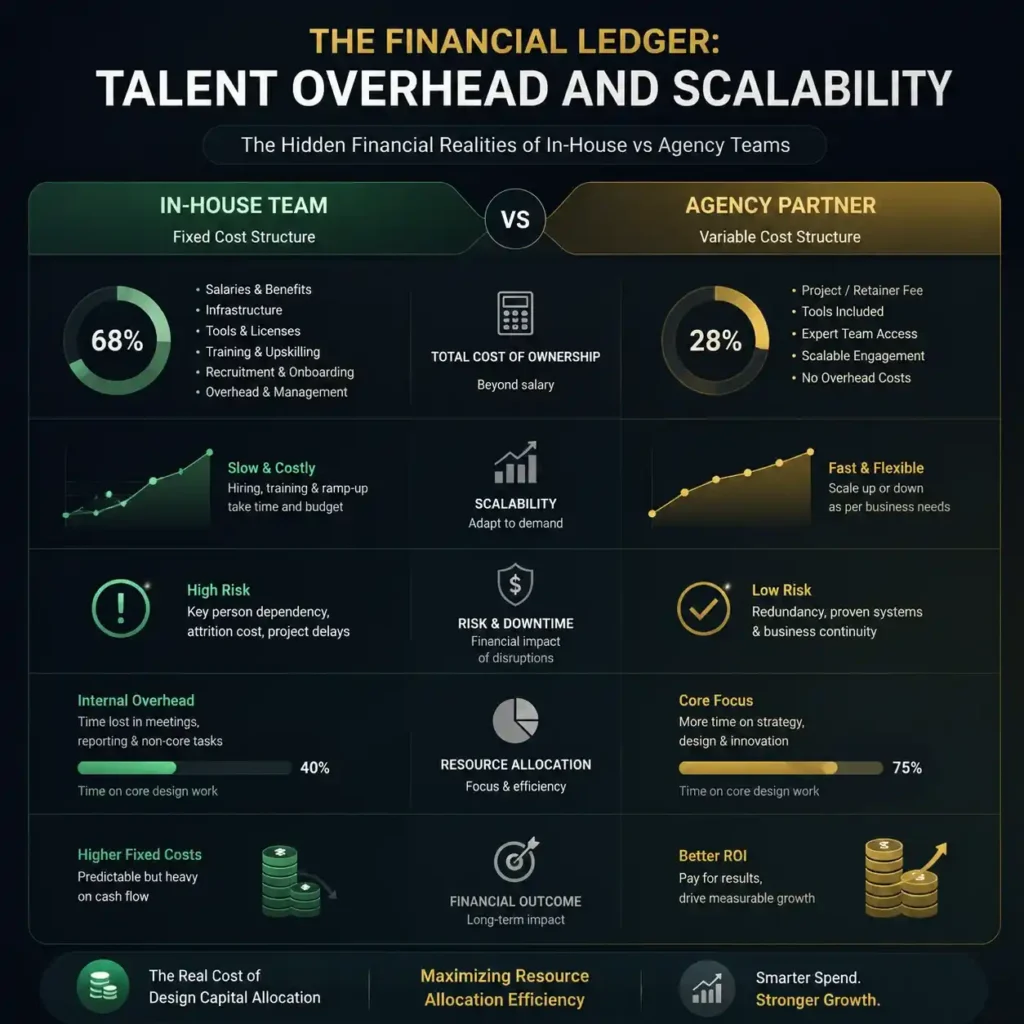
The financial reality of product development extends far beyond simple hourly rates. True fiscal efficiency requires analyzing long-term liability, operational flexibility, and resource utilization.
The Hidden Financial Realities of In-House vs Agency Teams
When companies calculate the cost of an internal team, they often look only at base salaries. They routinely underestimate the massive talent acquisition overhead required to build a competitive product team. Recruiting top-tier senior UI/UX designers, interaction specialists, and user researchers in 2026 demands significant capital.
The true cost of building an internal design team in 2026, salaries, benefits, and recruitment fees combined runs significantly higher than most companies budget for and the breakdown reveals why so many teams get this wrong.
Beyond salaries, you must factor in recruitment fees, stock options, health benefits, expensive hardware configurations, and continuous software licensing costs. If a key designer departs mid-project, your entire product development cycle grinds to a costly halt while you scramble to find a replacement.
The Real Cost of Design Capital Allocation
| Fixed Overhead (In-House) | Variable Allocation (Agency) |
| Full-Time Executive Salaries | Milestone-Based Contracts |
| Health & Benefit Packages | Scale Down During QA Phases |
| Recruiting & Onboarding Costs | Scale Up For Major Overhauls |
Maximizing Resource Allocation Efficiency
An external agency eliminates these fixed financial liabilities by transforming fixed overhead into variable costs. This structural flexibility provides exceptional resource allocation efficiency. When your mobile app requires a massive, zero-to-one design overhaul, you can instantly deploy an agency’s entire cross-functional team of researchers, UI specialists, and motion designers.
Once the core design architecture is completed and handed off to production, you can scale your agency resource consumption down to a baseline maintenance model. Trying to scale an internal team up and down in this manner is logistically impossible and financially damaging.
Achieving True Design Team Scalability
Furthermore, an agency provides instant design team scalability. If your product roadmap suddenly demands a simultaneous launch across iOS, Android, and web platforms, an established agency can immediately scale up its billable hours and assign more specialists to your project. They handle the internal management, resource scheduling, and operational risks, allowing your executive leadership to focus entirely on core business growth.
Long-Term Asset Management and Quality Control
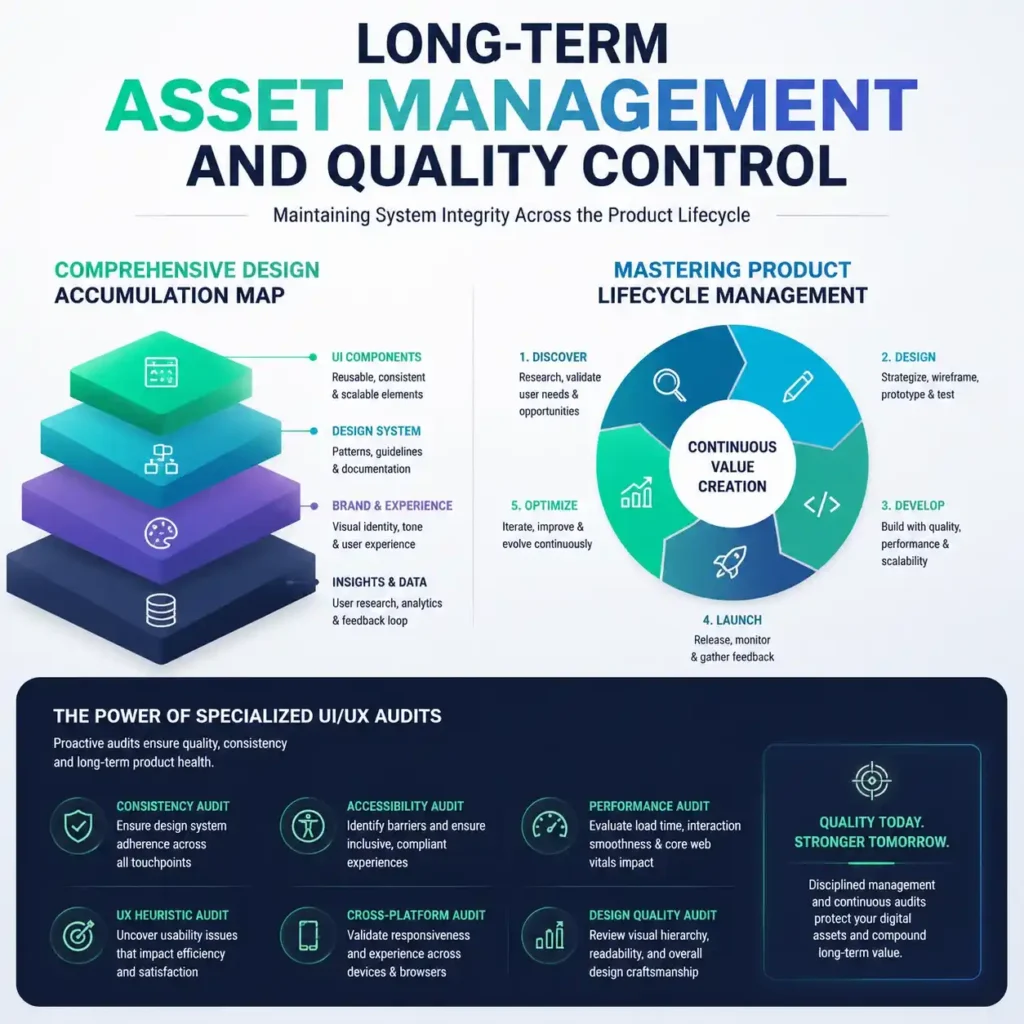
A mobile application is not a static project that you finish and forget. It is an evolving digital product that requires continuous maintenance, optimization, and structural management throughout its entire operational lifespan.
Maintaining System Integrity Across the Product Lifecycle
To scale a digital product without breaking its user interface, you must maintain absolute design system continuity. A design system is a comprehensive component library containing typography scales, button states, and spacing tokens used across your app.
Internal teams excel at maintaining this continuity because they own the system daily. Lazy agencies, by contrast, often deliver one-off custom screens that ignore existing design tokens. This introduces messy inconsistencies into the codebase that your developers will eventually have to spend time and money fixing.
Comprehensive Design Accumulation Map
| Stage | Description |
| 1 | Specialized UI/UX Audits (Uncover Friction Points) |
| 2 | Design System Continuity (Lock In Component Tokens) |
| 3 | Product Lifecycle Management (Continuous Optimization) |
Mastering Product Lifecycle Management
Managing these long-term challenges requires an analytical approach to product lifecycle management. Your design needs to change as your product moves from its initial launch to a mature market position.
During the initial growth phase, you need rapid experimentation and high-impact design sprints. In the mature phase, your focus shifts to iterative feature testing and user onboarding optimization. A top-tier agency supports you through these transitions by providing structured, long-term roadmaps rather than disjointed, transactional assets.
The Power of Specialized UI/UX Audits
Even mature internal teams must periodically leverage external expertise through specialized UI/UX audits. When internal teams work on the same layout for too long, they lose their objectivity. They become blind to conversion drops and clunky user journeys.
Bringing in an analytical external eye to dissect your data, map user friction, and audit your conversion funnels is the only way to keep your product performing at its peak. This objective evaluation safeguards your user retention metrics over time.
FlowmazeUX: The Hybrid Velocity Force
Evaluating the trade-offs of an In-House vs Agency model shows that you do not have to settle for a compromise. Our experts at FlowmazeUX eliminate this dilemma by operating as a high-velocity hybrid partner. We combine the deep, integrated collaboration of an internal team with the raw speed, objective perspective, and scalability of an elite global studio.
Find out what sets top product development teams apart from mediocre ones in our selection of the best agency for designing UI/UX of mobile apps.
We establish clear technical alignment with your developers, build scalable design systems, and run exhaustive, data-driven audits to optimize your application’s performance. The team takes complete ownership of your product’s interactive quality, giving you an elite design team without the burden of long-term corporate overhead. Collaborate with our dedicated UI/UX Design Agency to create highly performant mobile experiences that drive your product growth.
Frequently Ask Questions
For early-stage startups, an agency is almost always more cost-effective. Building an internal team introduces massive, fixed financial liabilities through talent acquisition overhead. An agency allows you to pay exclusively for targeted design production, helping you launch your product without carrying full-time salary liabilities before finding product-market fit.
Top-tier agencies build your visual assets using cloud-based design systems like Figma, using standardized component libraries and design tokens. This ensures that every new screen, pop-up, or button state automatically inherits your app's core brand rules, preventing style inconsistencies in your application code.
This friction is almost always caused by poor communication and weak technical alignment. If an agency works in isolation without continuously verifying its concepts with your engineering lead, it may deliver complex layouts that slow down your developers' build schedules.
Elite agencies do not guess; they run exhaustive discovery phases. They use data-driven competitor research, target user interviews, and stakeholder workshops to master your specific industry's regulations, user expectations, and behavioral nuances before designing a single screen.
Companies bring in agencies to execute specialized UI/UX audits and disrupt internal design stagnation. Internal teams frequently grow blind to their own product's usability flaws. An external studio provides a fresh, objective perspective to help uncover and resolve conversion bottlenecks.
True alignment means your design partner actively participates in technical scoping calls alongside your engineering leads. Every interaction model, animation, and layout shift is checked against your tech stack's constraints before production begins, eliminating wasted coding hours.
A dedicated agency partner adapts to your product's changing growth stages. They transition from executing high-speed, zero-to-one product designs during your launch phase to providing conversion optimization, feature additions, and platform scale design support as your user base matures.
A professional design agency operates under strict master services agreements that explicitly transfer 100% of intellectual property, design files, code repositories, and asset systems to your company upon milestone payment completion. You retain total ownership of your product.