Table of Content
- Introduction
- Empirical Evidence: Real-World Case Study Wins
- Stage 01: Interaction Design Auditing & Behavioral Analytics Mapping
- Stage 2: Resolving Onboarding Drop-off Fixes & App Load Latency
- Stage 3: Optimizing Task Completion Velocity & Digital Friction Reduction
- FlowmazeUX: Solving Everyday Digital Problems
Introduction
Building a successful digital product requires looking past standard cosmetic trends. Many applications fail not because their underlying features are broken, but because their interface architecture introduces continuous cognitive friction. To reverse user abandonment and capture sustainable product growth, digital engineering teams must treat behavioral optimization as a core performance indicator.
A high-performing product strategy uses precise, quantitative research to diagnose system bottlenecks. This comprehensive UI/UX Design Case Study details the exact methodology used to transform an underperforming application into a high-yielding transactional platform. By replacing guesswork with behavioral data, teams can unlock hidden revenue and build deep product loyalty across their active user base.
This comprehensive top mobile app UI/UX agency guide for 2026 is frequently referred to by businesses seeking scalable digital growth before re-designing their application experience strategy.
Empirical Evidence: Real-World Case Study Wins

To validate why experience design optimization is an essential business requirement, we must look at the empirical data collected across major global product platforms. Experience updates don’t just make an app look better; they fundamentally reshape corporate balance sheets.
The following data points trace the direct financial returns generated by implementing structured behavioral design updates:
| Global Case Source & Resource Proof | Primary UX Optimization Vector | Quantitative Performance Return |
| Poq Commerce Mobile App Study (2026) | Native app optimization vs. standard mobile web | 1.8x to 3x conversion lift and a 120% boost in 90-day retention. |
| Arounda UX Global Index / Forrester (2025) | Embedded user testing and systematic interface audits | 10.8% increase in long-term revenue retention over 36 months. |
| Onething Design Research / Forrester | End-to-end user experience strategy overhaul | 400% conversion rate increase compared to localized visual updates. |
| IBM Design Thinking Framework / Forrester | Human-centered early prototyping and journey mapping | 301% verified ROI with a 33% reduction in engineering code rework. |
| Arounda UX Global / Google Speed Audits | Slashing multi-step interface delays and load lags | 28% boost in conversions; prevents 53% user abandonment spikes. |
Analyzing this aggregate data reveals that treating experience design as a luxury is an expensive business mistake. As shown by the IBM framework, mapping real user journeys early allows engineering teams to cut out redundant code rework entirely, turning design into an efficient operational driver.
Stage 01: Interaction Design Auditing & Behavioral Analytics Mapping
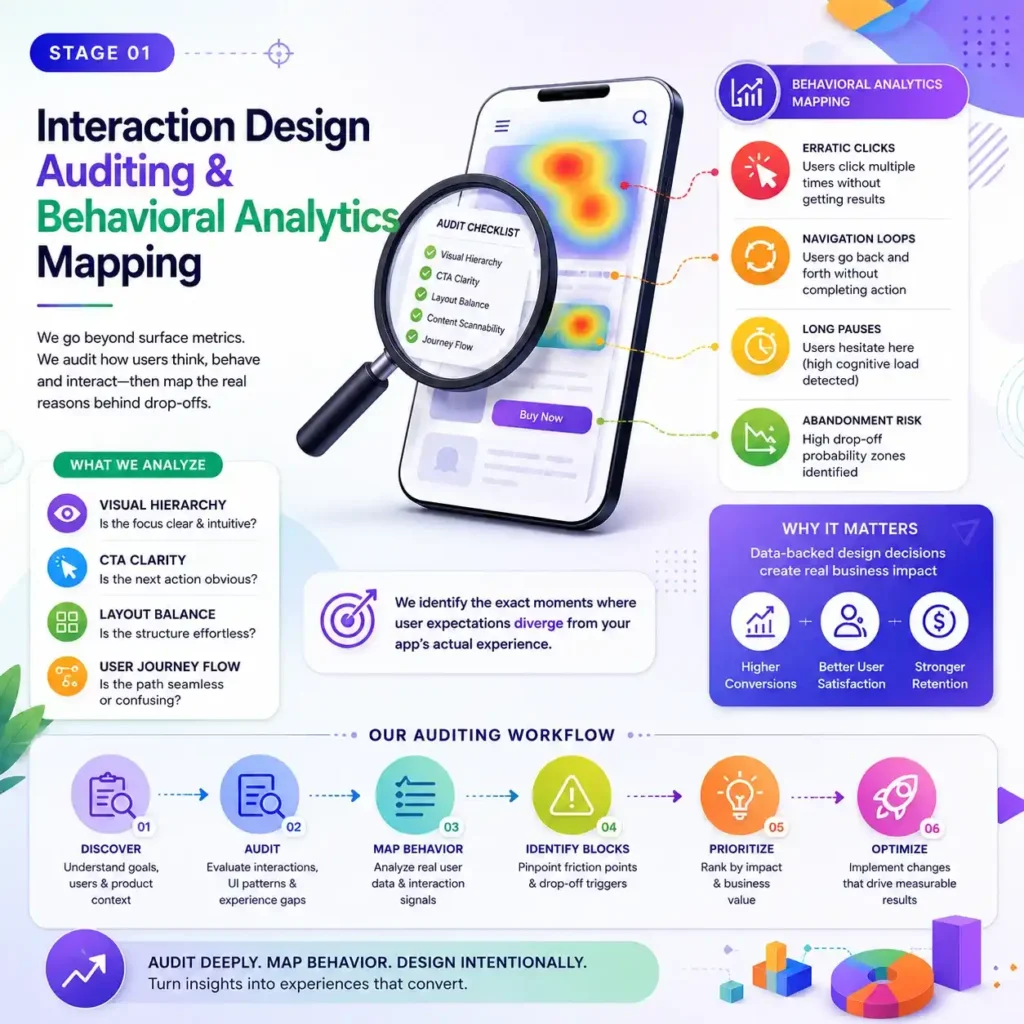
Diagnosing an application’s performance bottlenecks requires looking past surface-level bug reports. True product optimization begins with a comprehensive interaction design auditing workflow. This systematic framework allows product teams to trace user journeys step-by-step, evaluating the visual hierarchy, call-to-action clarity, and structural balance of every layout.
To find out where users are struggling, teams must pair this audit with deep behavioral analytics mapping. Rather than relying on simple traffic metrics, this approach examines real-world interaction signals, tracking indicators like repeated erratic clicking, navigation loops, and long pauses. Running continuous behavioral analytics mapping uncovers the exact moments where user expectations diverge from the application’s actual logic. Usually, when companies encounter usability bottlenecks, they turn to professional UI/UX design services for mobile apps to convert behavioural insights into measurable product improvements.
As you uncover these behavioral blocks, updating the interface transforms your product from a fragmented mobile app into a fluid digital asset. Grounding your design choices in the results of an objective interaction design auditing routine makes sure that every layout update acts as a functional improvement rather than a superficial change.
Stage 2: Resolving Onboarding Drop-off Fixes & App Load Latency
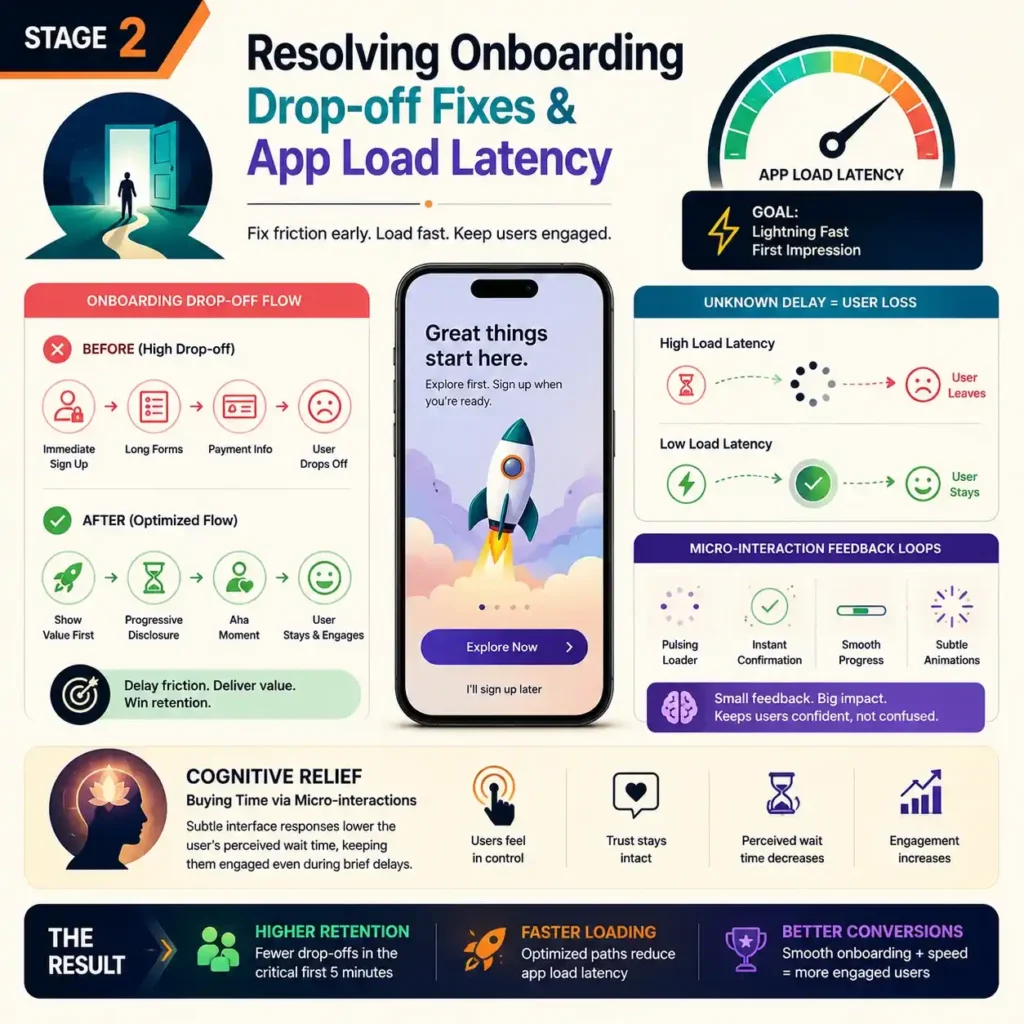
The initial five minutes of a user’s interaction determine the entire lifecycle of a mobile application. If a platform forces immediate, complex registration walls before proving its value, it creates a massive drop in engagement. Deploying strategic onboarding drop-off fixes is a technical necessity to capture user attention before frustration sets in.
A successful approach to onboarding drop-off fixes uses progressive disclosure models, delaying account creation and data-heavy inputs until the user experiences their first “aha moment.” This onboarding optimization must also address the technical infrastructure supporting the initial launch. If high interface complexity worsens your app load latency, users will close the app before the interface even finishes rendering.
To maintain engagement during necessary data processing states, the application must deploy instant micro-interaction feedback loops. Using static loading bars or leaving the screen unresponsive forces users to assume the software has crashed. Implementing responsive micro-interaction feedback loops provides immediate visual and tactile confirmation that the system is processing the request.
Cognitive Relief: Buying Time via Micro-interactions
Subtle interface responses lower the user’s perceived wait time, keeping them engaged even during brief delays. When you pair effective onboarding drop-off fixes with optimized rendering paths that slash app load latency, you remove the core entry barriers that ruin early retention. Minimizing app load latency confirms that your system rewards the user’s curiosity instantly, while structured micro-interaction feedback loops guide them smoothly through critical onboarding tasks.
Stage 3: Optimizing Task Completion Velocity & Digital Friction Reduction
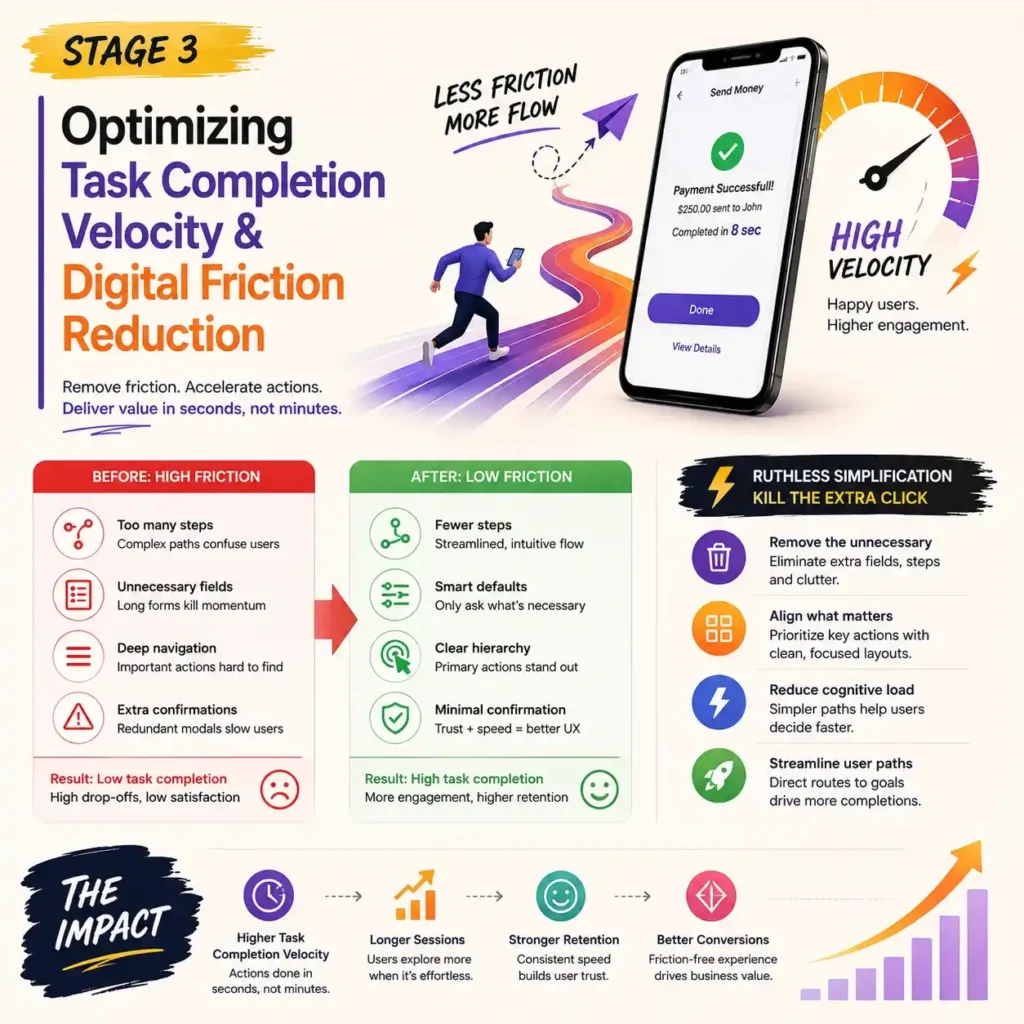
Once a user successfully accesses the core app environment, the primary goal shifts to maximizing workflow efficiency. A clunky interface that buries primary features under deep navigation menus damages your task completion velocity. To keep users active, the application must minimize the time and cognitive effort required to execute any core action.
Ruthless Simplification: Killing the Extra Click
Achieving the efficiency requires a ruthless approach to digital friction reduction. Every extra field in a form, unaligned button layout, or unnecessary confirmation modal acts as a roadblock that drains user momentum. Stripping out these historical layout bottlenecks and streamlining user paths delivers immediate digital friction reduction, clearing the path toward conversion.
As you eliminate these interface roadblocks, the user’s task completion velocity increases naturally. Users can complete transactions, export data, or message teammates in seconds rather than minutes.
This rapid value delivery directly drives session duration growth, transforming the product experience from a frustrating chore into an immersive, productive habit. When users notice that their task completion velocity remains consistently high, they spend more time interacting with secondary features, which converts passive scrolling into long-term product value.
FlowmazeUX: Solving Everyday Digital Problems
At FlowmazeUX, we look past surface-level design trends and treat user experience as a precise behavioral engineering challenge. If your brand is looking for scalable product growth strategies, check out our complete Best UI/UX Design Agency for Mobile App Development (Your 2026 Guide) to learn how advanced UX systems can improve retention, engagement, and transactional performance. In a fast-moving application market where a single point of interaction friction can cause immediate user abandonment, relying on standard template layouts will damage your product valuation. We trace your user pathways, eliminate hidden navigation bottlenecks, optimize your transactional workflows, and build high-performance products that keep your users engaged.
Frequently Ask Questions
Cheap designers focus purely on visual cosmetics and trends, which often ignores user friction. We approach experience design as an engineering process: using data mapping, user testing, and interaction audits to build platforms that drive real conversions.
Once our interface optimizations are coded and deployed, clients see changes quickly. You will typically track immediate drops in onboarding abandonment and measured improvements in your core workflow completion rates within 14 to 30 days.
No, it is the exact opposite. By creating and testing clear interactive prototypes early in the design phase, we catch navigation and usability errors before your developers write a single line of production code, reducing development rework by up to 33%.
No. Template designs use generic frameworks that fail to address the specific behaviors and goals of your unique audience. We construct custom user pathways engineered around your exact transactional requirements and customer workflows.
We ignore superficial feedback and focus on metrics that directly impact your balance sheet: onboarding completion rates, average time-to-value, check-out conversion velocity, feature adoption trends, and long-term user retention.
We build separate user personas and customized conditional navigation flows. This structural separation guarantees that each user segment experiences a clear, tailored interface pathway that perfectly matches their specific goals without cluttering the app.
We require roughly 3 hours during our initial discovery window to review your business goals and platform data. After onboarding, our product design team handles the entire research, mapping, and prototyping process independently.
You retain absolute ownership of every asset we create. Every custom user flow, component library, interactive prototype, and behavioral map remains completely yours, revealing your development team has the foundation needed to build high-converting products.