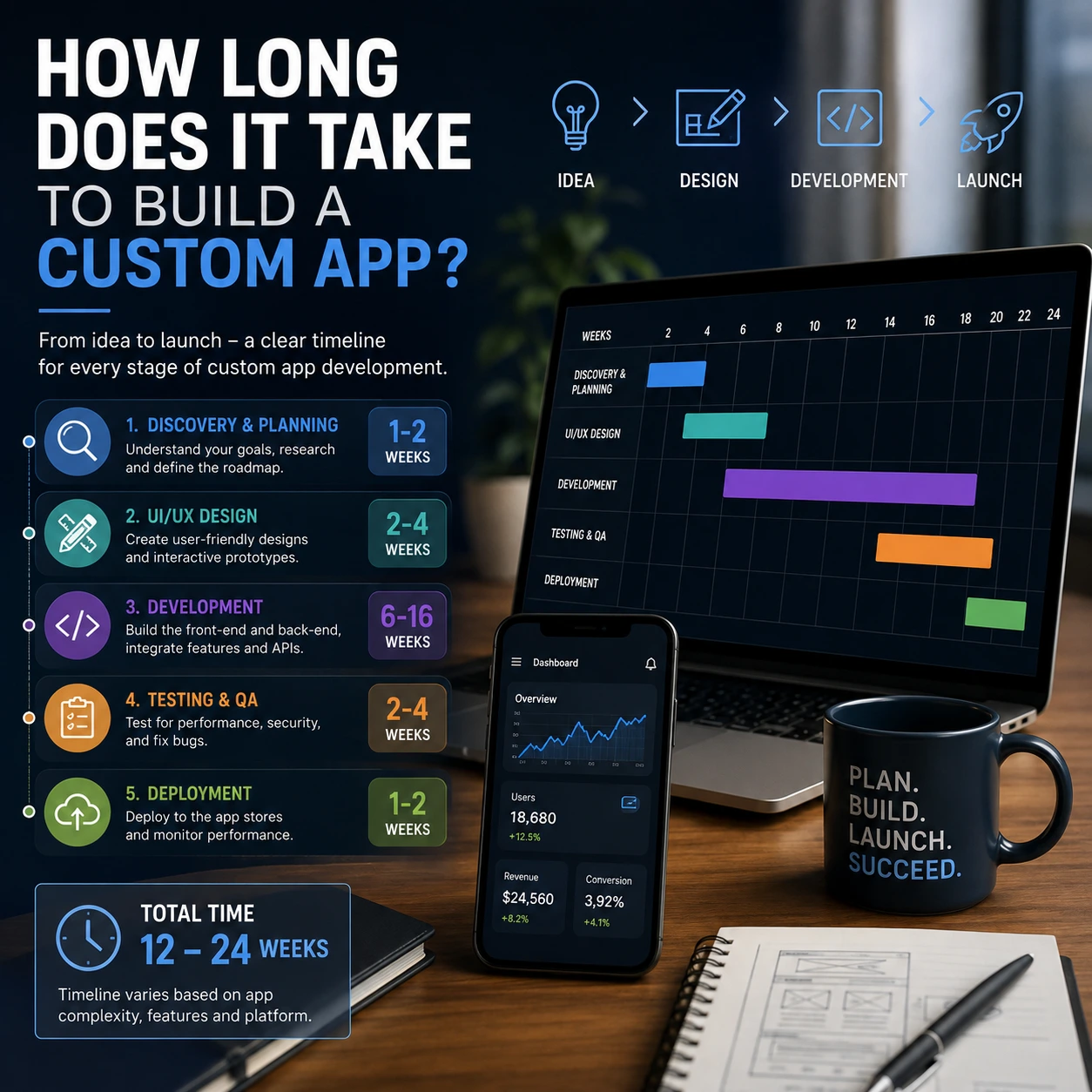
We all have the same question—How long? However, from a technical point of view, the exact schedule to build a custom app depends heavily on technical complexity, platform choices, and feature density. Most software engineering projects should have three to nine months from initial concept validation to production launch. Establishing clear milestone expectations prevents budget overruns, aligns engineering teams, and keeps product launches on schedule.
Before you start calculating the project deadlines, it is important to understand the whole development lifecycle, from planning and designing to deploying and maintaining it. Learn more about the whole process and benefits of custom solutions at our Custom Mobile App Development Services: Complete Guide.
Realistic Timelines to Build a Custom App
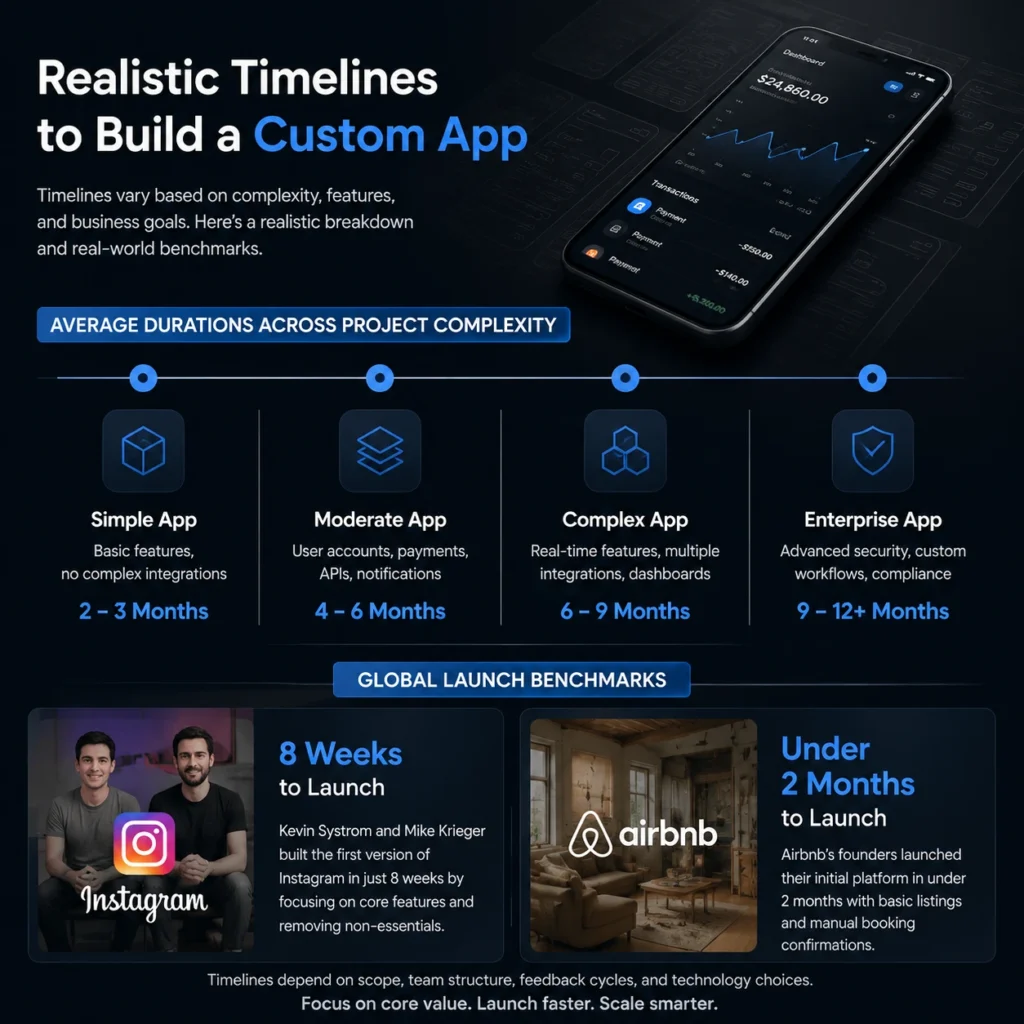
To be specific: planning to build a custom app leads to balancing feature complexity against market release speed. Simple digital products ship in eight to twelve weeks, while feature-rich enterprise platforms need six to twelve months of engineering.
Average Durations Across Project Complexity
Software delivery timelines scale based on custom database architecture, API connectivity, and security layers. A baseline digital tool takes two to three months, whereas a mid-sized platform with user accounts, payment gateways, and real-time notifications demands four to six months. Industry research from GoodFirms indicates that over 62% of software projects encounter schedule adjustments, with unexpected scope revisions and delayed design feedback serving as primary drivers.
Global Launch Benchmarks from Instagram and Airbnb
Global technology giants launched their initial products by cutting non-essential features to achieve rapid market entry. Kevin Systrom and Mike Krieger took exactly eight weeks to build and ship the first version of Instagram in 2010 after stripping away extraneous location check-ins from their prototype. Similarly, the founders of Airbnb launched their initial site in under two months with basic listings and manual booking confirmations. Focus on core user value rather than exhaustive feature lists during early development.
Detailed App Development Stages Breakdown
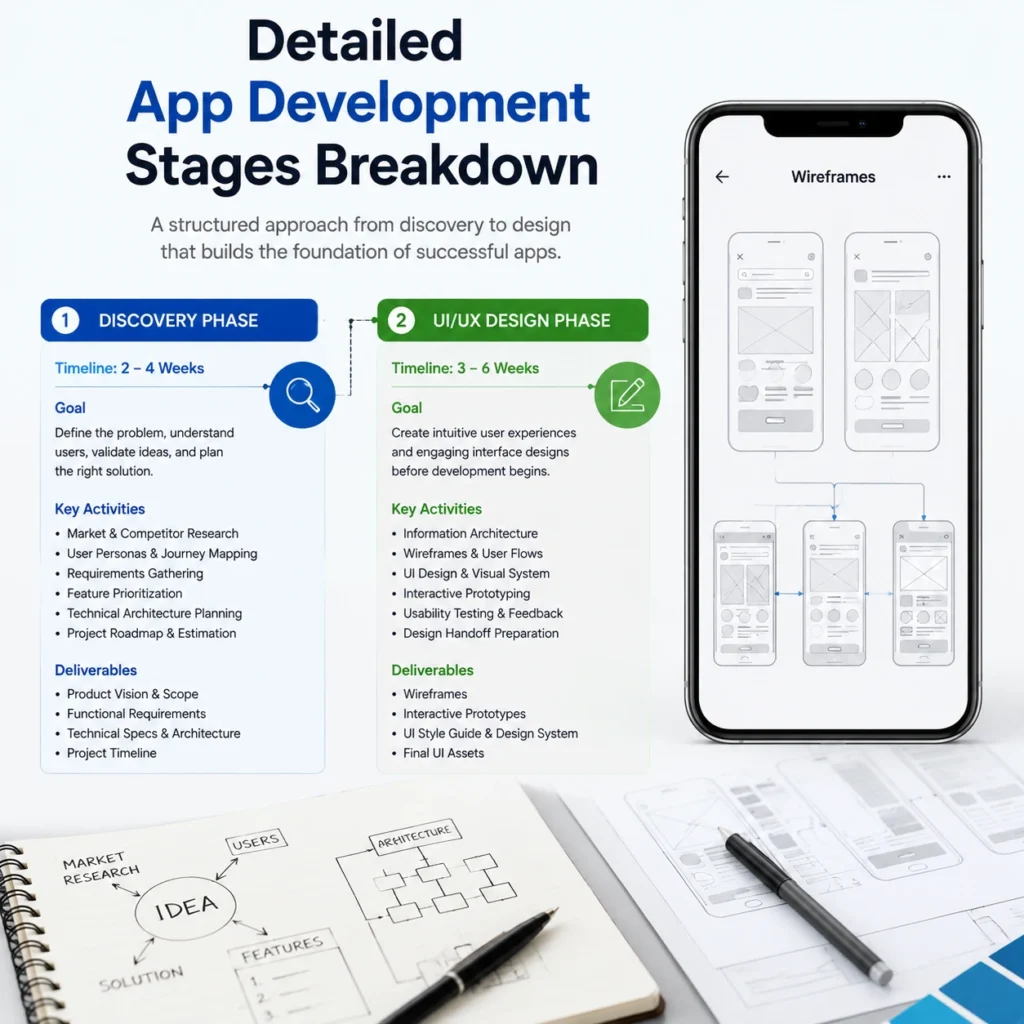
A structured app development stages breakdown divides complex software delivery into measurable, sequential phases. Skipping discovery or rushing design architecture creates costly rework during code integration.
App Discovery Phase Timeline and Requirements
Allocating two to four weeks for an app discovery phase timeline establishes precise functional specs and system logic. During this phase, business analysts and tech leads define target user personas, establish technical stack dependencies, and construct API blueprints. Resolving architectural questions early prevents mid-sprint revisions that disrupt development timelines.
UI UX Design Phase Duration and Wireframes
A standard UI/UX design phase duration spans three to six weeks depending on user flow complexity. Designers create wireframes, interactive prototypes, and modular UI component libraries that specify every button state and screen transition. Finalizing user interface assets before frontend coding eliminates developer idle time and reduces design iteration friction.
TYPICAL CUSTOM APP TIMELINE BY PHASE
| Phase | Duration | Deliverable |
| Discovery & Architecture | 2 – 4 Weeks | Scope & Specs Freeze |
| UI/UX Design Systems | 3 – 6 Weeks | Prototypes & Design Kits |
| Agile Development Sprints | 8 – 16 Weeks | Frontend & Backend Code |
| Quality Assurance & QA | 2 – 4 Weeks | Regression & Security |
| App Store Deployment | 1 – 2 Weeks | Review & Live Release |
Strategic Frameworks to Build a Custom App Faster
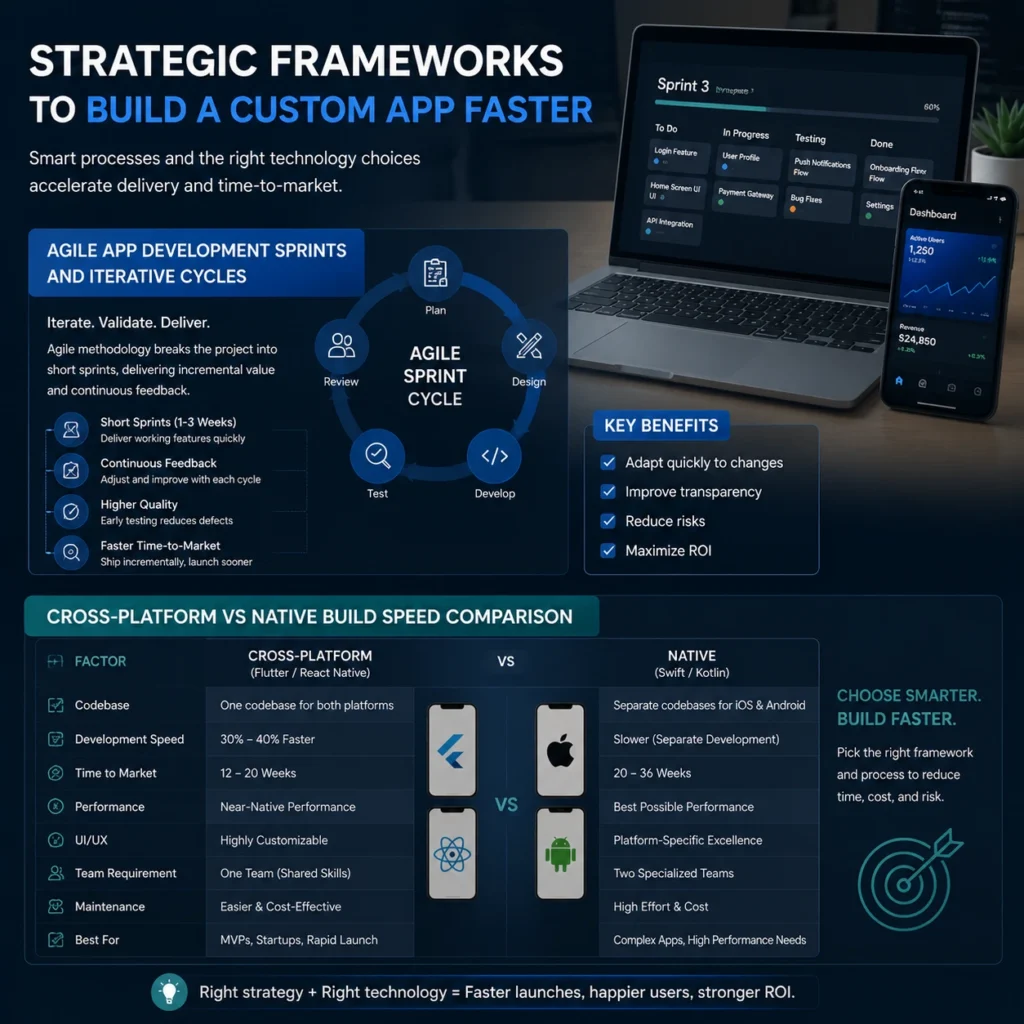
Selecting modern engineering frameworks and delivery models allows teams to build a custom app with maximum efficiency. Strategic technology choices directly determine code reuse and release frequency. Collaborating with seasoned people drastically reduces development risks and improves delivery schedules. Discover our Custom Mobile App Development Services to create a scalable app that suits your business needs.
Agile App Development Sprints and Iterative Cycles
Developers ship functional code increments every sprint, allowing stakeholders to review progress continuously. This iterative feedback loop catches technical defects early and permits minor feature pivots without derailing the overall delivery timeline.
Cross-Platform vs Native Build Speed Comparison
The evaluation of cross-platform vs. native build speed reveals significant differences in developer velocity and launch timelines. Frameworks like Flutter or React Native allow engineers to deploy iOS and Android applications from a single codebase, reducing total development time by 30% to 40%. Native iOS and Android development demands separate engineering teams and dual codebases, extending launch timelines but offering maximum hardware performance.
BUILD TIME COMPARISON MATRIX
| Approach | Timeline | Notes |
| Minimum Viable Product (MVP) | 8 – 12 Weeks | Core Function Only |
| Cross-Platform Deployment | 12 – 20 Weeks | Unified Codebase |
| Dual Native iOS & Android | 20 – 36 Weeks | Separate Teams |
| Enterprise Custom Ecosystem | 36 – 52+ Weeks | Heavy Compliance |
Critical Factors Delaying App Launch Schedules
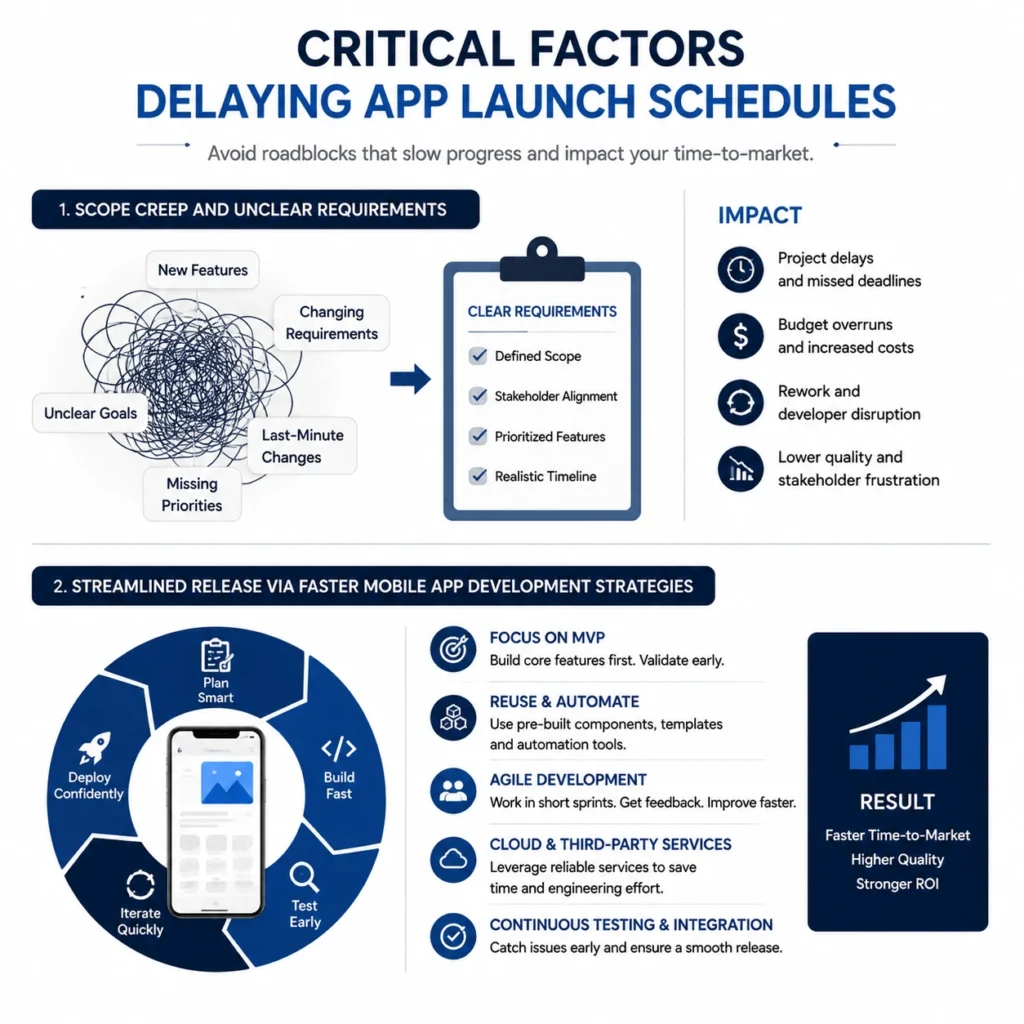
Uncontrolled scope expansion and communication breakdowns remain the most common factors delaying app launch dates. Proactive governance protects release targets from unnecessary delays.
Scope Creep and Unclear Requirements
Late requests force developers to refactor database schemas and re-test existing functionality. Implementing strict change control procedures preserves launch dates and keeps engineering budgets intact.
Streamlined Release via Faster Mobile App Development Strategies
Applying faster mobile app development strategies asks freezing core features two sprints before target release dates. Automating continuous integration, utilizing pre-built backend services for authentication, and mocking API endpoints enable frontend and backend developers to work simultaneously without waiting on dependencies.
FlowmazeUX: Product Design Partner for High-Growth Software
FlowmazeUX creates simple, beautiful, and effective interfaces for digital products. Our design team transforms complex software ideas into clean mobile applications and web dashboards that users love.
We build complete Figma design systems, interactive prototypes, and clear visual guidelines that help your developers code faster with fewer mistakes. By solving user flow friction early in the design stage, FlowazeUX helps your business launch on schedule and keep customer retention high.
Frequently Ask Questions
A streamlined Minimum Viable Product typically can go for eight to twelve weeks of dedicated design and engineering effort. Focusing strictly on primary user actions allows startups to validate concepts in live market conditions without sinking months into unproven features.
The discovery phase usually lasts two to four weeks. This phase covers market research, technical architecture planning, API mapping, and feature prioritization to establish clear project boundaries before development starts.
Design duration depends on screen count, user role complexity, interactive prototyping depth, and feedback review speed. Standard design phases take three to six weeks, while complex enterprise platforms with multi-role dashboards take six to ten weeks.
Agile sprints divide total workload into two-week iterations featuring explicit deliverables. Regular sprint demos allow product owners to review functional builds continuously, identify defects early, and maintain predictable velocity throughout the development lifecycle.
Cross-platform frameworks use a single shared codebase for iOS and Android, eliminating duplicate frontend development. Native development should have separate Swift and Kotlin codebases managed by distinct engineering teams, increasing build times and testing overhead.
Unclear initial requirements, mid-project scope creep, unstable third-party APIs, insufficient regression testing, and app store compliance rejections represent primary triggers for launch delays. Freezing feature scope two sprints before launch minimizes release risks.
Key acceleration tactics include establishing reusable UI design components, building frontend and backend in parallel using mock APIs, implementing continuous integration pipelines, and prioritizing an MVP feature scope for initial launch.
Apple App Store and Google Play Store review cycles generally take one to seven days after final binary submission. Submitting complete metadata, clear privacy documentation, and working test credentials prevents administrative rejections and submission delays.