
Building a mobile application represents only half of your software investment. Planning for the costs after launch of mobile app products keeps cloud servers live, fixes sudden code bugs, and protects your app from getting removed by Apple or Google store audits. Understanding these ongoing expenses is also an important part of planning custom mobile app development because the initial development budget is only one part of the application’s total lifecycle cost.
Founders and inspiring entrepreneurs assume software costs end once an application lands in the app store. That mistake leads to broken server links, unhandled crashes, and unhappy customers. Setting clear financial budgets for hosting fees, third-party integrations, and operating system updates protects your digital product over its entire lifespan.
Essential Budgets for Costs After Launch of Mobile App Products
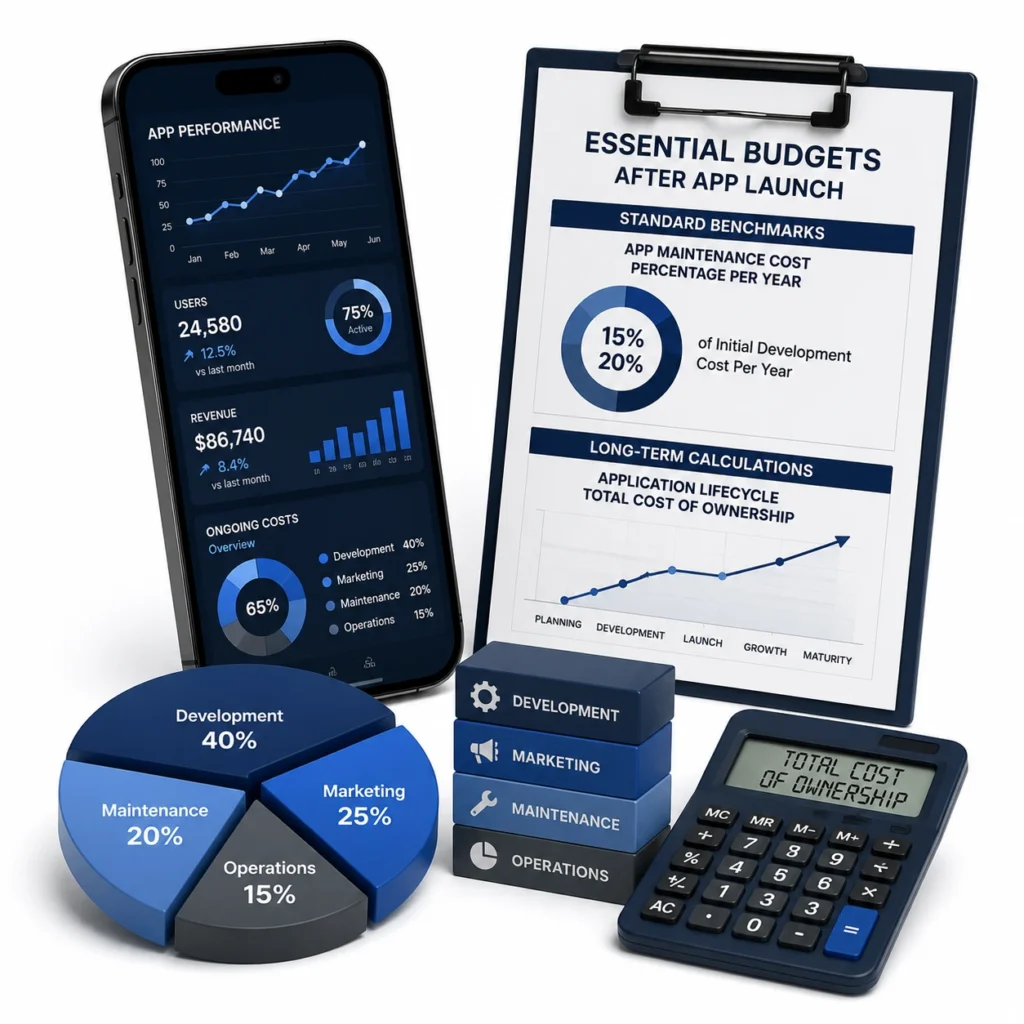
Industry data shows that ongoing software support swallows 50% to 80% of total product expenses over five years. Planning your operational budget for the costs after launch of mobile app products prevents surprise bill shocks as user traffic scales up.
Standard Benchmarks via App Maintenance Cost Percentage Per Year
Set an app maintenance cost percentage per year of 15% to 20% of your initial build budget to establish a realistic financial baseline. A project that takes $100,000 to construct usually demands $15,000 to $20,000 annually for stable operations. First-year support often reaches 50% of original development costs while developers resolve early user feedback and balance database servers.
Long-Term Calculations via Application Lifecycle Total Cost of Ownership
Calculate the application lifecycle total cost of ownership to capture software updates, server upgrades, and ongoing security audits across a multi-year timeline. Over a five-year lifecycle, subscription tools and server hosting expenses routinely surpass original design costs. Calculate your complete operational budget with this mathematical equation:
Unexpected Expenses Driven by Costs After Launch of Mobile App Software
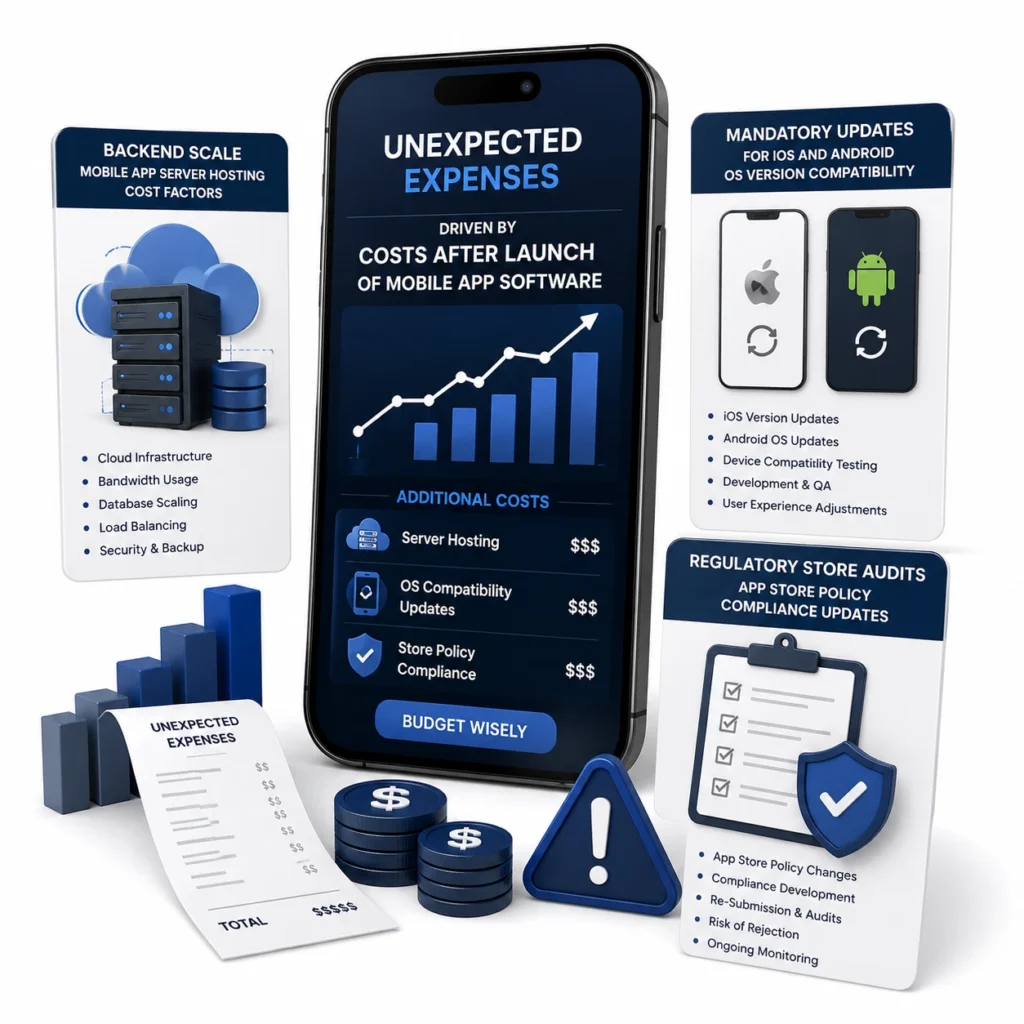
Unforeseen operational fees represent a massive portion of the costs after launch of mobile app products. Operating systems update yearly, cloud databases charge by user traffic, and app store policies shift constantly.
Backend Scale via Mobile App Server Hosting Cost Factors
Estimate your mobile app server hosting cost factors based on active user traffic, database queries, and media storage volume. A basic application with minimal traffic costs $70 to $320 per month for shared cloud servers (Too high as per recent reports). High-growth enterprise platforms with real-time sync and video uploads regularly exceed $5,000 per month as database loads expand.
| App Traffic Level | Average Monthly Server Expense | Primary Cost Drivers |
| Basic (Under 5k Active Users) | $70 – $320 / month | Shared database, simple file storage |
| Mid-Scale (5k – 50k Active Users) | $1,000 – $5,000 / month | Dedicated cloud instances, payment processing |
| Enterprise (50k+ Active Users) | $5,000 – $20,000+ / month | Real-time database sync, global CDNs, auto-scaling |
Mandatory Updates for iOS and Android OS Version Compatibility
Maintain iOS and Android OS version compatibility to shield your software from sudden screen layout breaks and broken system permissions. Apple and Google release major operating system upgrades every autumn. Code updates and UI checks across fresh device screens take 40 to 80 developer hours per platform, adding thousands of dollars in annual engineering expenses.
Regulatory Store Audits via App Store Policy Compliance Updates
Pass App Store policy compliance updates to prevent automatic app removal and account suspension. In 2024 alone, Google Play delisted over 1.1 million abandoned apps that failed to update target API levels. Fresh privacy policies, active consent banners, and updated SDK permissions keep your product visible in public app stores.
Codebase Optimization and Operational Maintenance
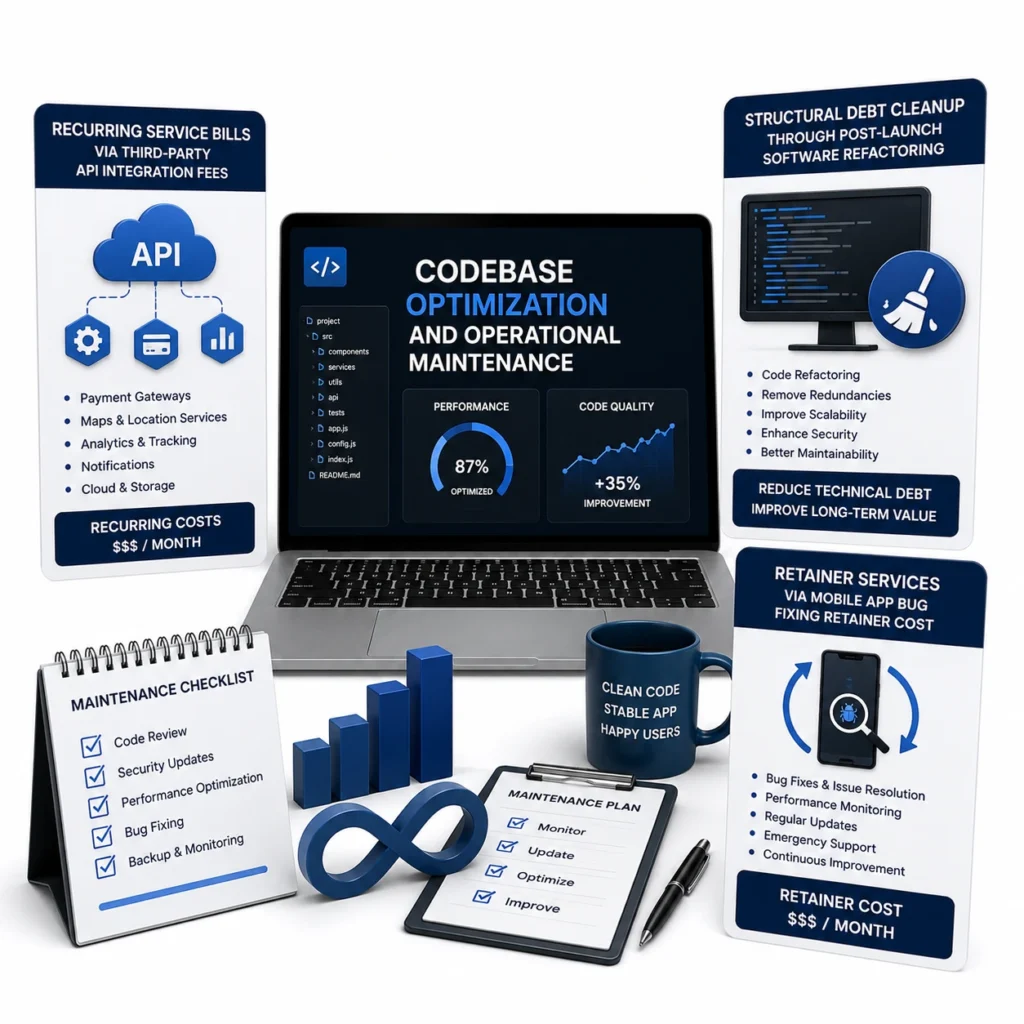
Code health degrades over time as fresh features attach to legacy database structures. Continuous maintenance prevents technical debt from slowing down user screens. Building a scalable architecture from the beginning, as discussed in our complete guide to custom mobile app development, can also make future maintenance and feature expansion easier.
Recurring Service Bills via Third-Party API Integration Fees
Track third-party API integration fees to manage monthly tier costs for maps, push notifications, analytics, and payment gateways. Software components like Stripe, Twilio, Firebase, or Google Maps charge per transaction or active user. As your customer base grows, these external software bills increase alongside server hosting invoices.
Structural Debt Cleanup through Post-Launch Software Refactoring
Schedule post-launch software refactoring to keep your codebase fast, clean, and easy for new developers to modify. Quick workarounds created during initial launch sprints slow down screen loading times over time. Clean code modules every six months to reduce crash rates and lower future feature development costs.
Retainer Services via Mobile App Bug Fixing Retainer Cost
Lock in a mobile app bug fixing retainer cost to secure dedicated engineering hours every month for unexpected errors. Software agencies typically offer monthly retainers ranging from $1,500 to $5,000 for mid-sized applications. This arrangement gives product teams instant access to developers without paying high emergency hourly rates.
Real-Time Performance and Emergency Protection
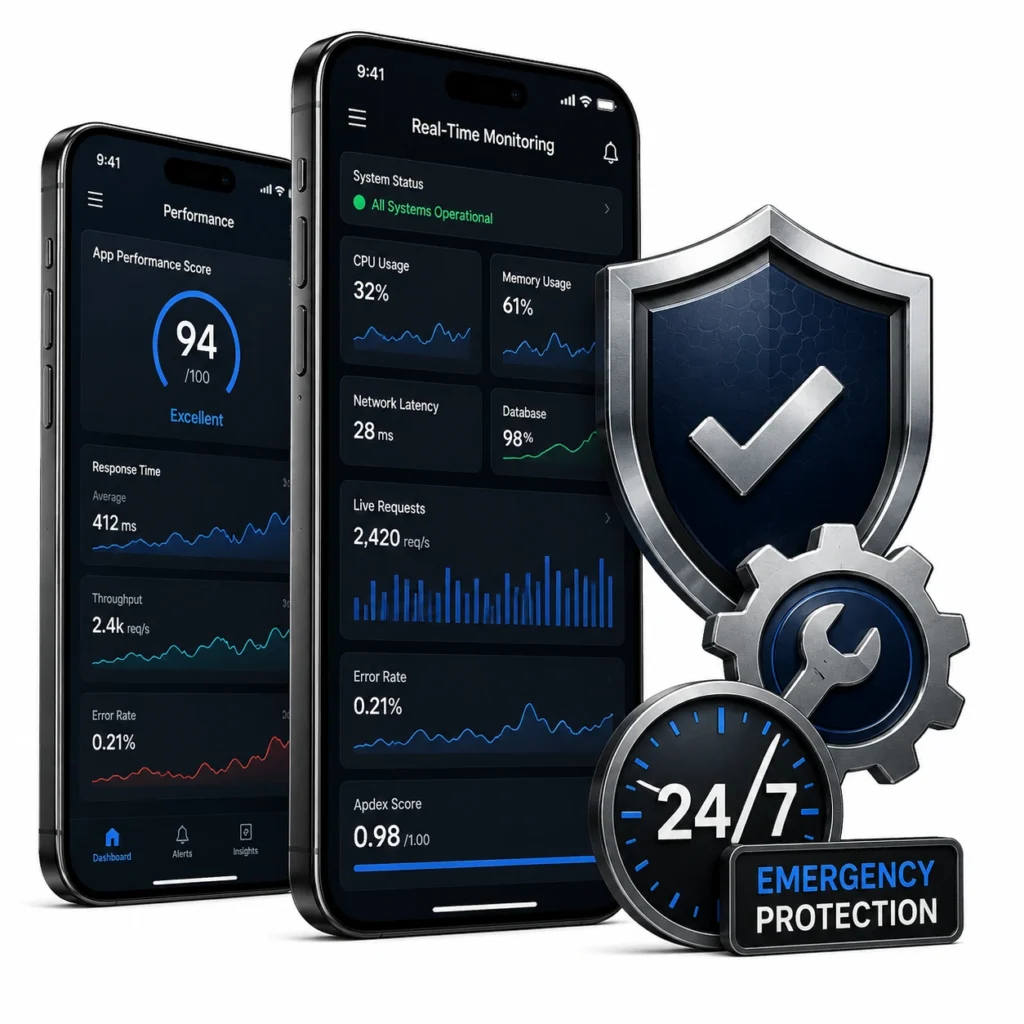
Application stability directly drives user retention. Over 62% of mobile users uninstall applications immediately after encountering a frozen screen or crash.
Diagnostic Metrics via Mobile App Performance Monitoring Tools
Embed mobile app performance monitoring tools to alert developers to hidden API crashes and memory leaks before users write bad store reviews. Services like Sentry, Datadog, or Firebase Crashlytics track screen load speeds and error logs in real time. Active performance monitoring maintains high crash-free session rates and protects brand reputation.
Sudden Outage Repairs through Emergency App Downtime Response Cost
Reserve capital for an emergency app downtime response cost to shield your company against server outages, payment gateway failures, and security breaches. Unplanned downtime stops incoming revenue and damages user trust. Emergency developer calls on weekends or holidays carry premium rates, making contingency cash reserves essential for operational survival.
FlowmazeUX: Expert UX Design for Durable Mobile Products
FlowmazeUX creates clean, intuitive, and efficient user interfaces for modern mobile applications. Our design team builds scalable Figma design systems, interactive prototypes, and modular UI kits that keep software easy to maintain. you are planning a new application or need a scalable product architecture, explore our Custom Mobile App Development Services
Frequently Ask Questions
Main expenses include cloud server hosting, iOS and Android OS compatibility updates, third-party API subscription fees, app store compliance checks, bug fixes, and security patches.
Most businesses set aside 15% to 20% of their initial build budget every year for maintenance. First-year costs often rise toward 30% to 50% while resolving launch bugs and early user feedback.
Small apps with minimal traffic cost $70 to $320 monthly for basic cloud hosting. Large applications with real-time data sync, image uploads, or streaming spend $1,000 to $5,000+ per month as database loads expand.
Apple and Google update iOS and Android operating systems annually. Mobile software needs code updates and layout adjustments to stay compatible with new system security rules and device screen sizes.
App stores delist outdated applications that fail to meet new security, privacy, or API standards. Google Play and Apple routinely remove abandoned software to protect store security.
Refactoring cleans up messy code built during rushed launch sprints. Clean internal code structures speed up screen performance, lower crash rates, and reduce developer hours needed for future feature updates.
A monthly developer retainer covers set engineering hours to fix reported app crashes, resolve display glitches, update third-party plugins, and monitor server database health.
Performance tools detect hidden bugs, server timeouts, and slow screen transitions in real time. Catching errors early prevents app crashes, lowers uninstalls, and keeps customer retention high.