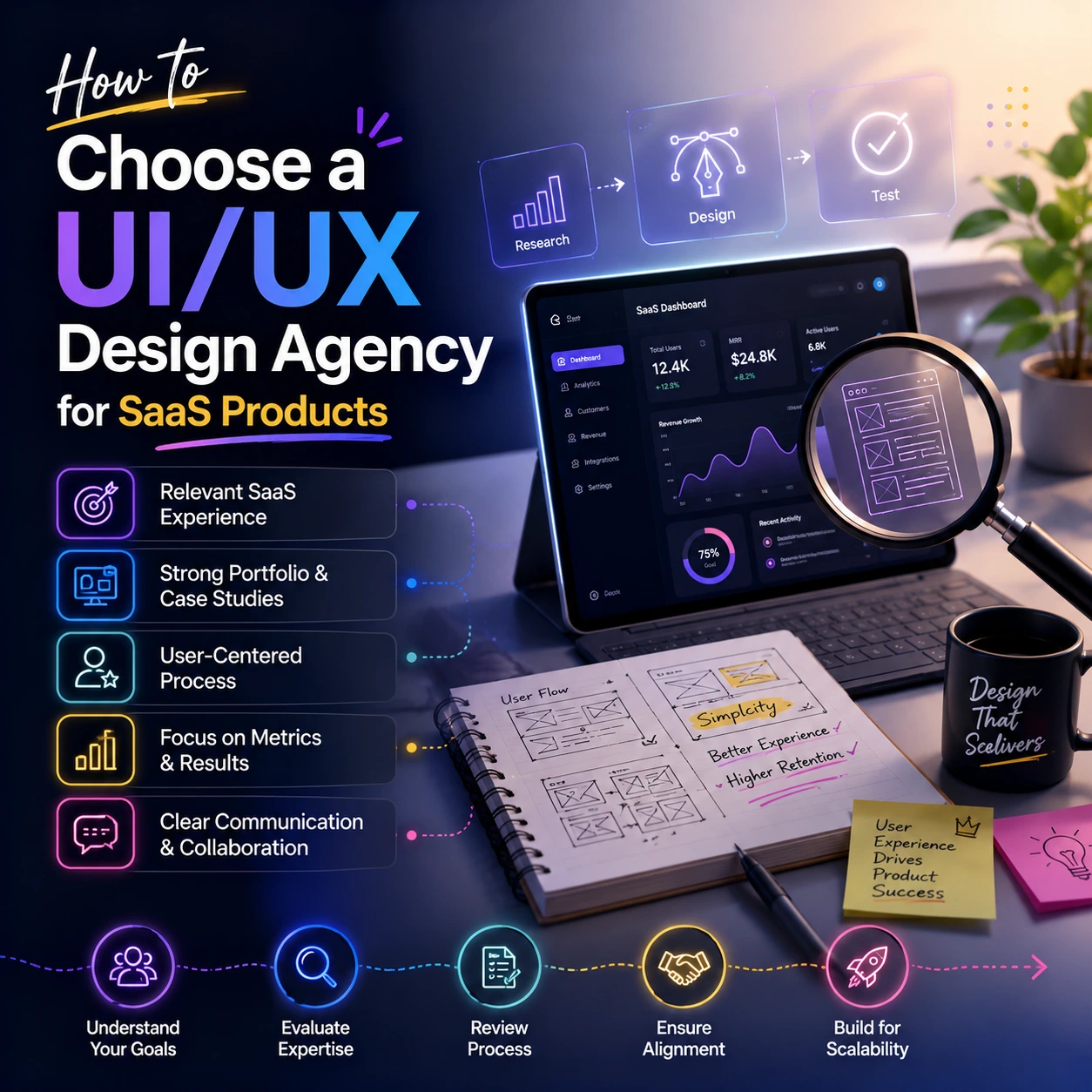
Software companies routinely incinerate their development capital by hiring traditional graphic design shops to structure highly technical application workspaces. A creative studio that builds beautiful, award-winning culinary blogs or fashion brand landing pages is fundamentally unequipped to design a multi-tenant accounting platform or an enterprise cloud repository.
When you set out to choose a UI/UX design agency, you are not shopping for aesthetic polish or trendy color palettes. You are searching for an elite engineering partner capable of translating dense, complex back-end operations into intuitive, fast-loading interactive systems that customers happily pay to use month after month. Organisations should look beyond visual aesthetics when choosing a Professional UI/UX Design Agency for SaaS Platforms, focusing instead on demonstrated SaaS experience, process optimisation, and measurable business results.
10 Quick Steps to Choose a UI/UX Design Agency for SaaS Products
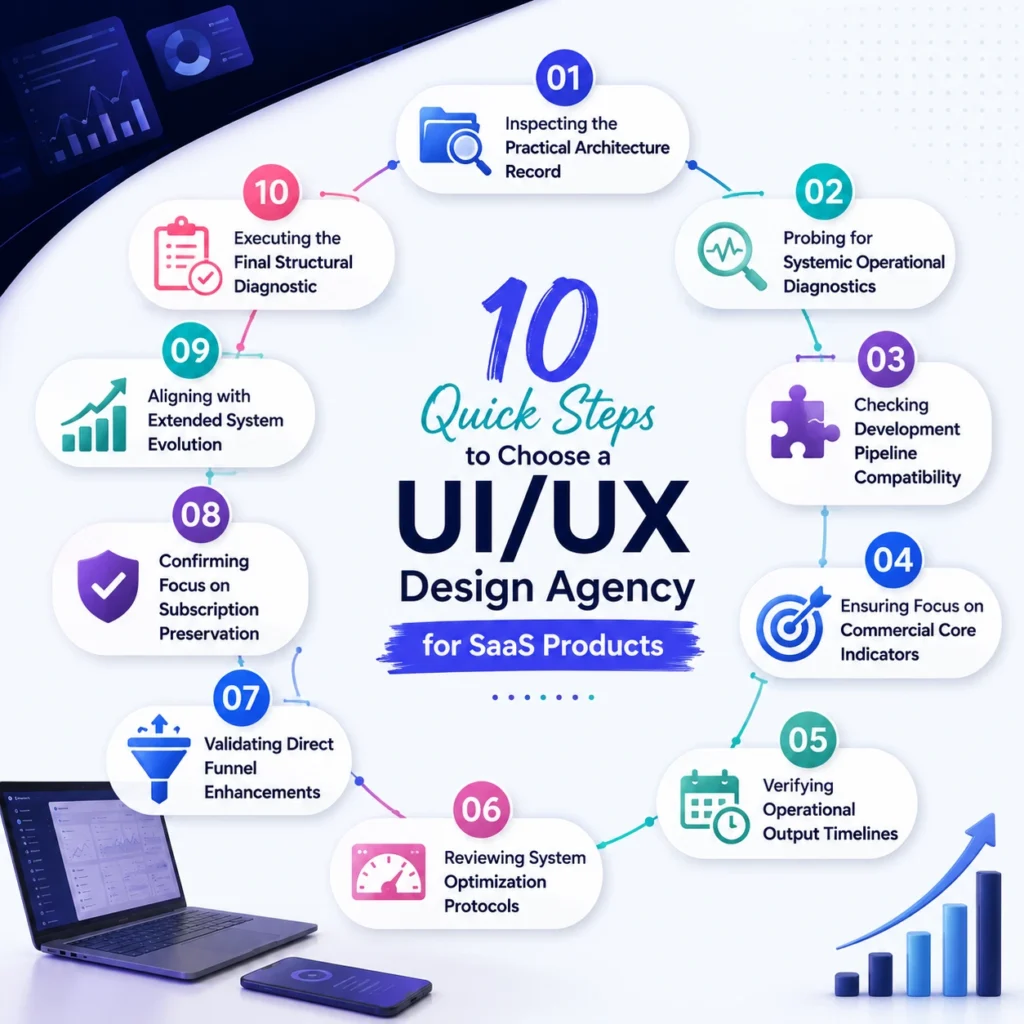
1. Inspecting the Practical Architecture Record
When evaluating a possible creative vendor, you need to divert your eyes away from static presentation slides and look at working solutions. Deep SaaS portfolio verification includes asking to witness live software environments where users negotiate complex workflows, nested data grids and multi-tiered permissions.
What to Look For:
- Live SaaS products, not static mockups
- Internal dashboards and operational workspaces
- Examples of complex workflows
- Systems with many roles of permissions
- Enterprise Software Success Stories
Questions to Ask:
- Can you demonstrate a live SaaS product?
Expect genuine navigation and data engagement.
- Developed logistics, healthcare, finance or ERP systems?
See if they’ve got a handle on enterprise complexity.
- How do you handle big data sets and difficult navigation?
They have to be scalable, working solutions.
2. Probing for Systemic Operational Diagnostics
Testing an agency’s ability to map sophisticated, multi-step business logic before signing a contract is an expensive error not to do. The professional application team must be adept in complicated workflow auditing.
What to Look For:
- Strong awareness of multi-step workflows
- Spot bottlenecks and duplicate steps
- Enterprise user process improvement
Questions to Ask:
- How do you analyse workflows with multiple steps?
We chart each stage, eliminate bottlenecks and superfluous steps.
- Can you streamline administrative processes?
Yes. We optimise workflows to reduce clicks and save time.
3. Checking Development Pipeline Compatibility
A beautiful interface concept is useless if your development team cannot actually program it. Look for agencies with strong interface engineering.
What to Look For:
- Knowledge of CSS grid layouts, component state and API constraints
- Hands-On Prototyping in Production Environments
- Design systems at scale (Figma etc.)
Questions to Ask:
- Are your designs feasible to implement efficiently by our developers?
Yes. All designs are made with actual development restrictions in mind.
- How do you manage real time data tables or large loads?
We design for scale, speed, and high volume data handling.
- Are your standards rigorous on interaction states and spacing?
Yes. Each component follows the same space and interaction guidelines.
4. Ensuring Focus on Commercial Core Indicators
Don’t trust an outside design firm that avoids your corporate growth goals. The best product teams trace every change in layout back to operational metrics.
What to Look For:
- Metrics-based design methodology
- KPI integration for activation & retention
- Evidence of past SaaS growth improvements
Questions to Ask:
- How can you translate UX into business metrics?
We tie design decisions to activation, retention and revenue goals.
- Did you have a commercial impact before?
Yes. We enhanced activation, adoption and retention metrics.
- What are the success metrics of activation?
Activation is measured by effective onboarding and first-value completion.
5. Verifying Operational Output Timelines
Software startups live and die by their shipping speed, which makes creative stagnation a massive operational liability for your funding runway. When vetting outside help, you need clear design velocity benchmarks to understand exactly how fast the vendor can iterate, prototype, and deliver production-ready assets.
For instance, ask them how many sprints it takes their team to design, test, and hand over an entire multi-tiered administrative settings panel. Internal software engineering analytics show that partnering with a team that maintains high design velocity benchmarks can accelerate overall product time-to-market by as much as 45%.
6. Reviewing System Optimization Protocols
Structured heuristic evaluation techniques are used to audit layouts against psychological principles to vet an agency.
What to Look For:
- Methods of heuristic evaluation and usability audits
- Reducing Cognitive Load and Preventing Errors
- Checks for consistency and speed
Questions to Ask:
- How can you identify the friction points?
We find out where users get stuck, trip or abandon projects.
- What usability frameworks do you utilise?
Usability testing, heuristic analysis and behavioural UX principles are used.
- Can you give me audit examples?
Yes. We give you with genuine SaaS audit findings and advice for improvement.
7. Validating Direct Funnel Enhancements
Optimised workspaces proactively convert trial users to long-term customers.
What to Look For:
- Past project conversion rates validation
- Evidence of improved activation with redesigned interface
- First-time user guided workflows
Questions to Ask:
- Can you show better trial to paid conversion?
Yes. We show how the UX improvements translate to paid conversions.
- How can you show funnel improvements?
We measure drop-off, conversion and task completion rates.
- Which characteristics were most impactful to adoption?
Easy navigation, faster onboarding, less complexity.
8. Confirming Focus on Subscription Preservation
High retention is about continuous value. UX has to focus on automation and time saving.
What to Look For:
- Continuous user engagement monitoring
- Retention-focused design strategies
- Visibility of time saved or ROI
Questions to Ask:
- How can you reduce churn through UX?
We remove friction and enable users get to value faster.
- Can you show me some dashboards focusing on retention?
Yes. Retention dashboards are used for engagement and usage trends.
- What are the advantages of automation that people see?
Automation saves time, cuts down on errors and boosts production.
A UI/UX Design Agency for SaaS Platforms may craft retention-centric experiences that enhance engagement and minimize customer turnover.
9. Aligning with Extended System Evolution
Software is a living mechanism that requires constant updates, fixes, and feature additions as your business expands over time. You cannot afford to hire a team that delivers a static package of images and vanishes; you need deep product lifecycle integration to make sure your visual assets grow alongside your engineering needs.
Likewise, when you decide to introduce AI-driven predictive insights into your data charts next year, your design library must be structured to accommodate those modules seamlessly. Securing a vendor that values product lifecycle integration confirms your design system remains flexible, clean, and highly scalable for years to come.
10. Executing the Final Structural Diagnostic
Before making a final financial commitment, you must put the agency through a comprehensive design partner evaluation to see how they collaborate under real pressure. Ask them to run a live audit of a single broken screen inside your current product during your screening interview.
Watch how they analyze the layout, ask about user behavior data, and suggest fast structural solutions. Running a thorough design partner evaluation before signing a contract reduces overall project misalignment issues by nearly 65%. This final test reveals whether you are hiring an expensive group of corporate order-takers or an elite team of strategic product advisors.
Fire the Graphic Artists and Hire an Application Architect

Treating your software layout like a secondary consideration is a direct path to a collapsing retention chart. If your customer success team spends its entire day running emergency training webinars just to teach corporate buyers how to navigate your main analytics layout, your interface is actively killing your business. When you choose a UI/UX design agency, you are choosing the literal engine that controls your customer onboarding speed, feature usage, and monthly recurring revenue stability.
Stop wasting your valuable runway funding on agencies that specialize in building glamorous marketing brochures. Invest in a dedicated team that treats software architecture like a precise science, removes the friction from your user workflows, and engineers interfaces built to turn casual trial accounts into lifetime software advocates.
We Design Systems That Make Money, Not Art Projects
FlowmazeUX is the dedicated product design powerhouse built specifically for complex cloud software platforms. We skip the slow corporate bureaucracy and abstract creative theories to deliver high-velocity layout engineering that scales. Our team doesn’t waste your time with multi-month discovery fluff or delicate layouts that break during actual development cycles. We’re a UI/UX Design for SaaS Platforms that help companies convert difficult operations into intuitive user experiences that deliver measurable business results. To see how expert teams improve activation, retention, and workflow efficiency, explore our guide on Professional UI/UX Agency for SaaS Platforms
Frequently Ask Questions
Web agencies are built to optimize linear marketing funnels, while specialized software design teams know how to map complex interactive states, dense data grids, and layered permission configurations.
Look for deep internal application screens, operational workflows, and live software examples that demonstrate how the agency manages dense informational displays and real user tasks.
By mapping out detailed user steps and data dependencies before coding begins, a thorough audit eliminates unexpected layout logic gaps that typically force developers to rewrite code.
Teams with this background deliver meticulously organized design systems that account for component mutations, responsive grids, and technical constraints, saving your development team hundreds of hours.
Clear velocity benchmarks ensure the design team can iterate quickly through complex feature feedback loops, keeping your product deployments moving fast without hitting creative roadblocks.
Heuristic reviews test your product against objective, proven human behavior principles, replacing personal opinions with data-backed solutions to fix user confusion.
Tying layout changes directly to core indicators reveals your design capital is being used to fix actual revenue metrics, like trial-to-paid activation or user churn.
Yes, structuring your layout components flexibly from day one highlights that future feature expansions can be integrated smoothly without requiring an expensive, full-scale product redesign.