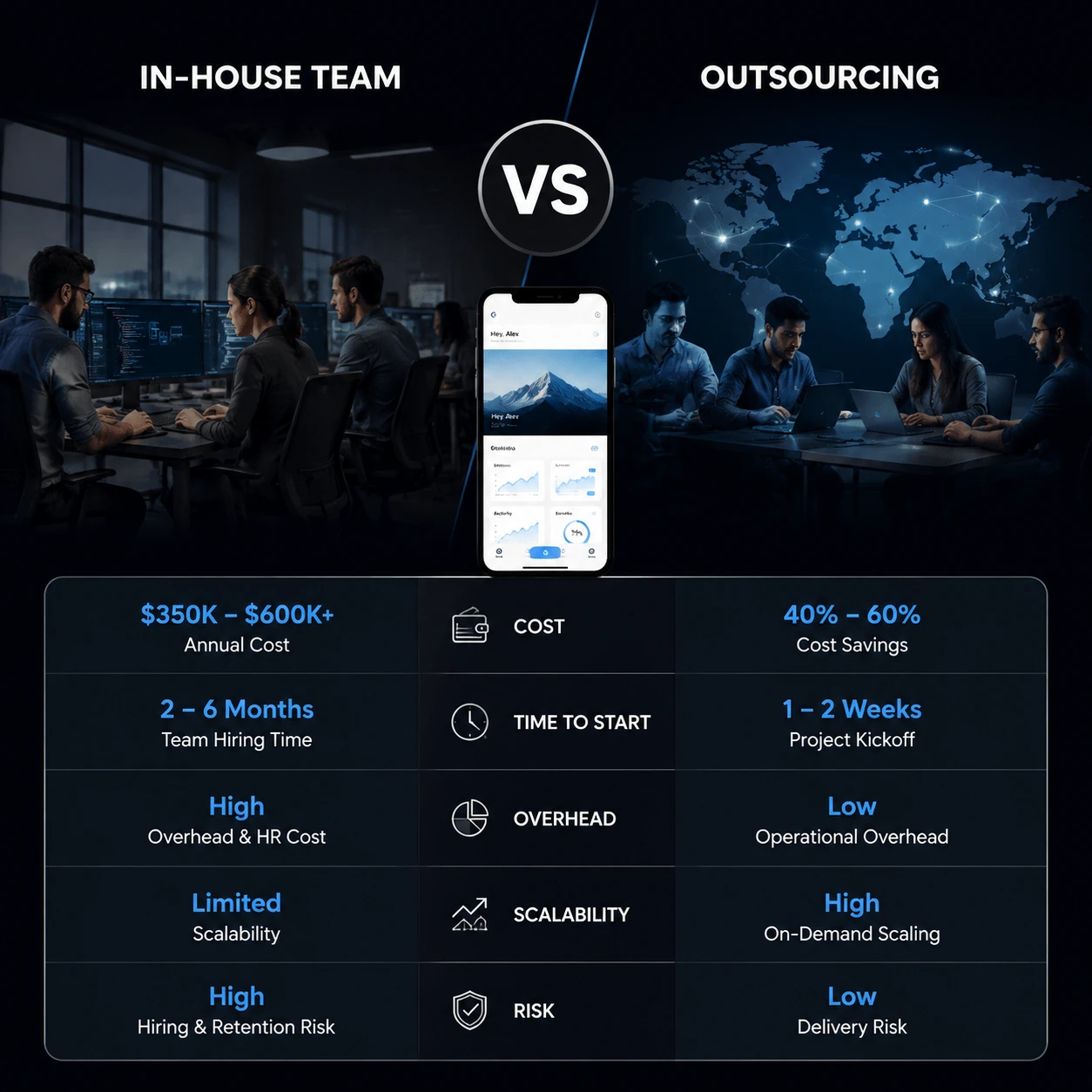
Selecting your software production model is an operational decision that directly dictates your capital runway, speed to market, and long-term codebase stability. Similarly, building digital assets requires balancing total control against massive corporate overhead and recruitment delays.
Founders fall into the trap of assuming an internal team is inherently safer, only to watch their burn rate surge while recruitment drags on for months. This guide breaks down the true financial and operational metrics behind in-house versus outsourced engineering, giving you the clarity needed to protect your runway and ship software on time. Before choosing a delivery model, review our complete guide to custom mobile app development services to understand the full process, technology options, development stages, and long-term maintenance requirements.
Direct Financial Realities of Internal vs External Engineering
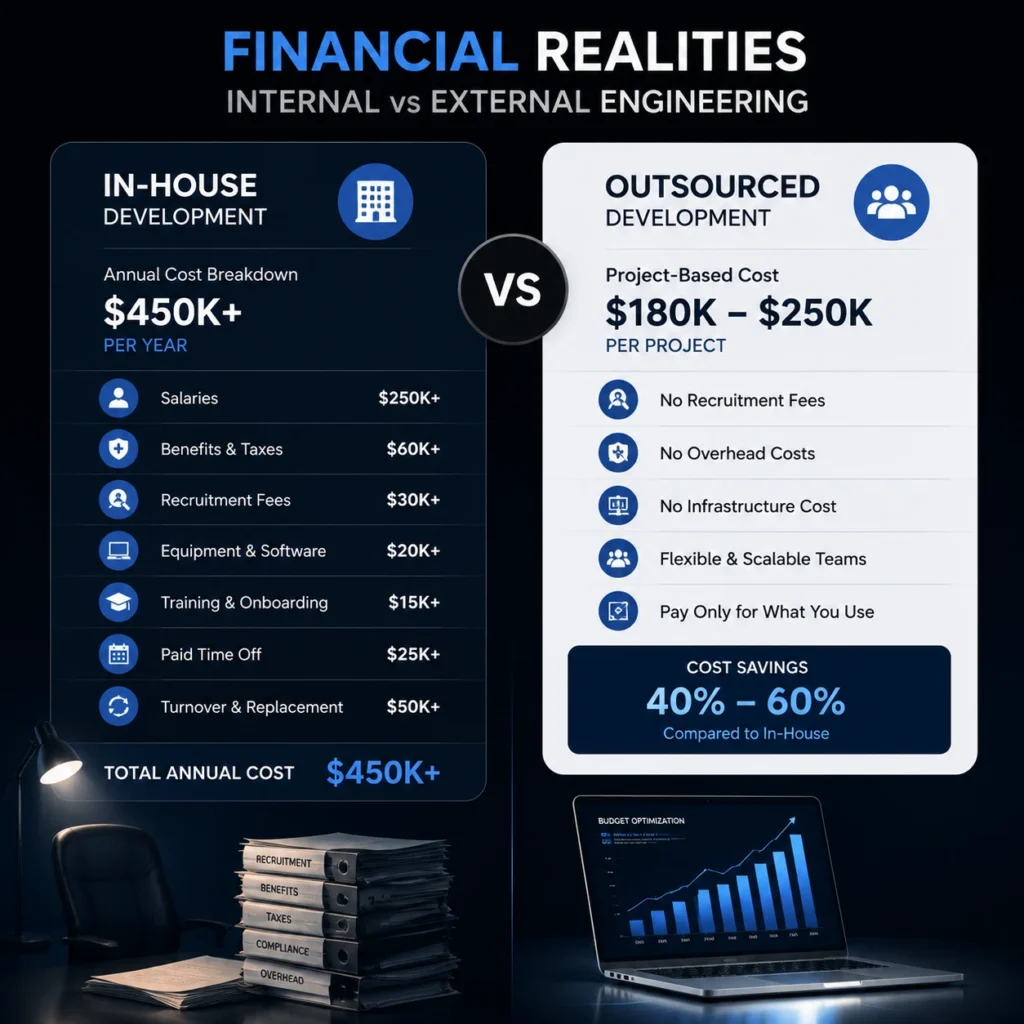
The true cost of internal mobile engineering is rarely limited to basic base salaries; it includes massive overhead, health benefits, equity grants, and hardware costs. Focusing solely on base salary comparisons obscures the actual operational drain of maintaining an in-house software division.
Calculating In-House vs Outsourced App Development Cost Metrics
An in-house app development team in North America routinely costs $350,000 to over $600,000 annually just to maintain a minimal core unit of a senior iOS developer, Android developer, UI designer, and QA tester. Conversely, partnering with a specialized outsourced agency allows you to convert massive fixed payroll liabilities into flexible, project-based variable expenses. Industry billing data shows that leveraging global engineering hubs slashes overall development expenditures by forty to sixty percent while providing access to identical technical capabilities.
Exposing Hidden Costs of Hiring Software Developers Internally
Hidden hiring expenses include recruitment agency fees, sign-on bonuses, corporate tax burdens, expensive software licenses, and paid time off. Recruitment agencies charge up to twenty-five percent of an engineer’s first-year salary just to source candidates, and equipping developers with high-end workstations and enterprise software suites adds thousands in upfront expenses. Furthermore, when an internal engineer leaves the company, you bear the total financial loss of lost productivity and the steep costs of recruiting a replacement.
Strategic Speed and Operational Flexibility
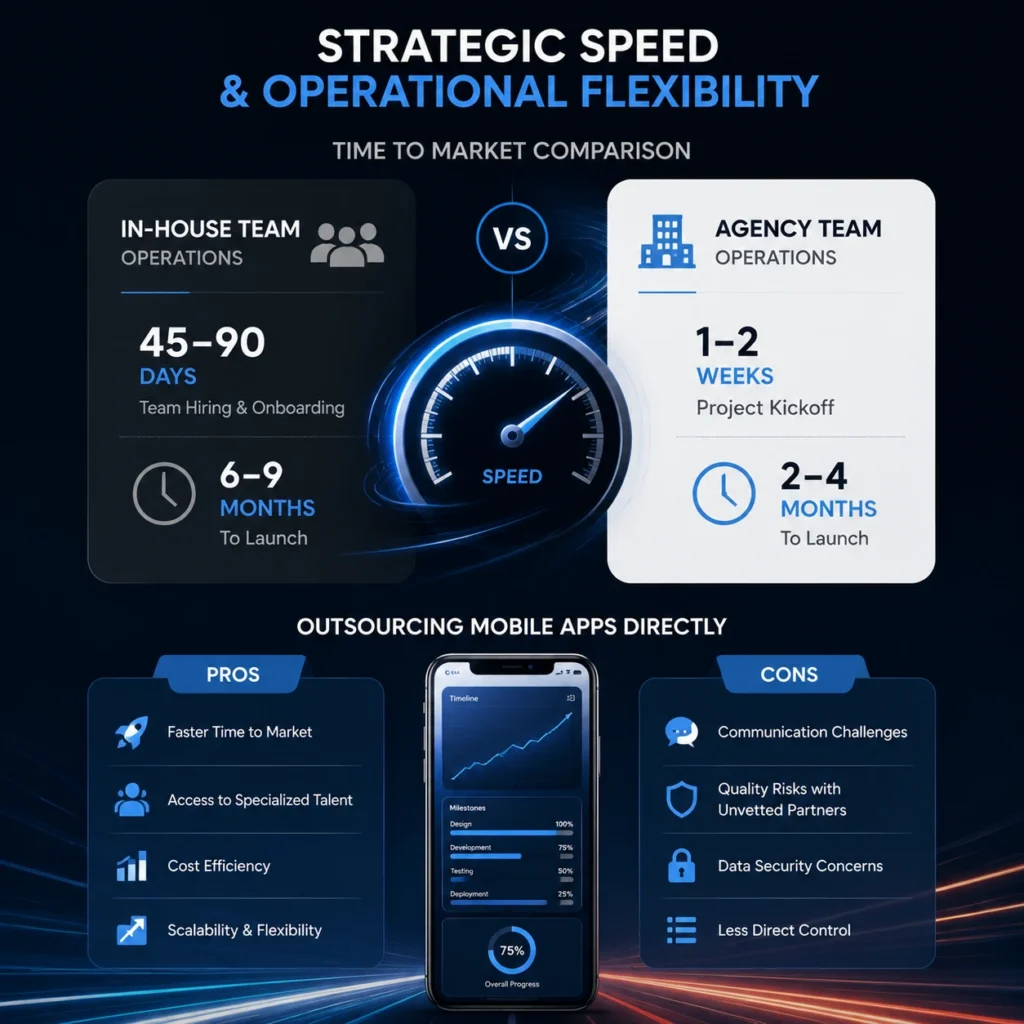
Speed to market determines whether your application captures early market share or gets buried by faster-moving competitors. Choosing an engineering model without factoring in initial team assembly timelines can delay your launch by months.
Analyzing Time to Market In-House vs Agency Operations
Launching an app with a newly assembled in-house team usually takes six to nine months, whereas an established agency can kick off active sprint development within two weeks. Sourcing, interviewing, vetting, and onboarding a full team of internal engineers takes an industry average of 45 to 90 days before a single line of production code is written. A pre-assembled agency skips the hiring bottleneck entirely, utilizing ready, fully integrated teams that jump directly into system architecture and feature development.
Evaluating Pros and Cons of Outsourcing Mobile Apps Directly
Direct agency outsourcing provides immediate access to specialized senior talent and rapid scalability, but requires rigorous vendor vetting to avoid communication friction. Outsourcing transfers the burden of team management, HR overhead, and technical infrastructure to your vendor, freeing leadership to focus on core business operations. The key risk lies in partnering with cheap, unvetted vendors who use poor coding practices, which is why choosing a transparent partner with open repository access is essential.
Structural Comparison of Engineering Delivery Models
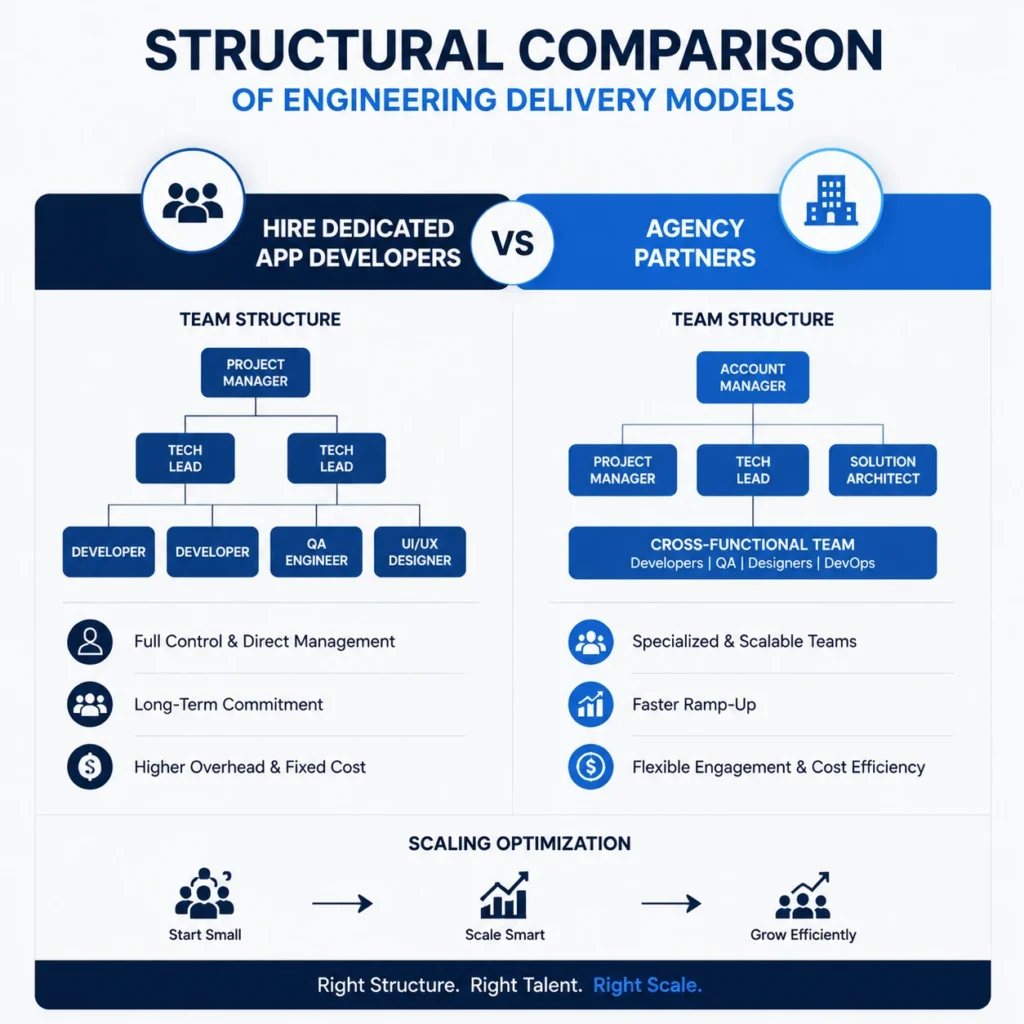
Choosing between direct agency contracts, dedicated development units, or direct hires dictates how daily development workflows are managed. Aligning your operational needs with the right engagement framework prevents management bottlenecks.
Estimating Hire Dedicated App Developers vs Agency Partners
Hiring dedicated app developers through a specialized vendor provides a middle ground, giving you full direct control over individual engineers without taking on payroll liabilities. Dedicated developers function as an immediate extension of your internal team, working exclusively on your repository while the vendor handles HR, equipment, and benefits. A full-service agency, by contrast, manages the end-to-end delivery of the software asset, taking full accountability for milestones, project management, and quality control.
Optimizing App Development Team Structure for Scaling
A high-performance mobile app team structure requires a balance of system architects, native or cross-platform developers, UI/UX experts, and QA automation engineers. Small startups often make the mistake of hiring a single “full-stack” internal developer expecting them to master mobile UI, backend scaling, database security, and app store compliance simultaneously. External agencies prevent these dangerous single-point-of-failure risks by deploying cross-functional specialists to handle each specific layer of your software stack. Your product’s scope, chosen technology, platform specifications, and delivery schedule all influence the optimal team makeup. How these elements affect project strategy, technical architecture, and total development cost is explained in our custom mobile app development guide.
According to global recruitment and tech labor data from SHRM and BLS, the average time-to-fill for senior software engineering roles routinely stretches past 45 to 90 days in competitive Western markets. When factoring in candidate drop-off rates and multi-round technical interviews, relying purely on internal hiring can delay critical product launches by up to two quarters.
Managing Remote Talent and Hybrid Sourcing Strategies
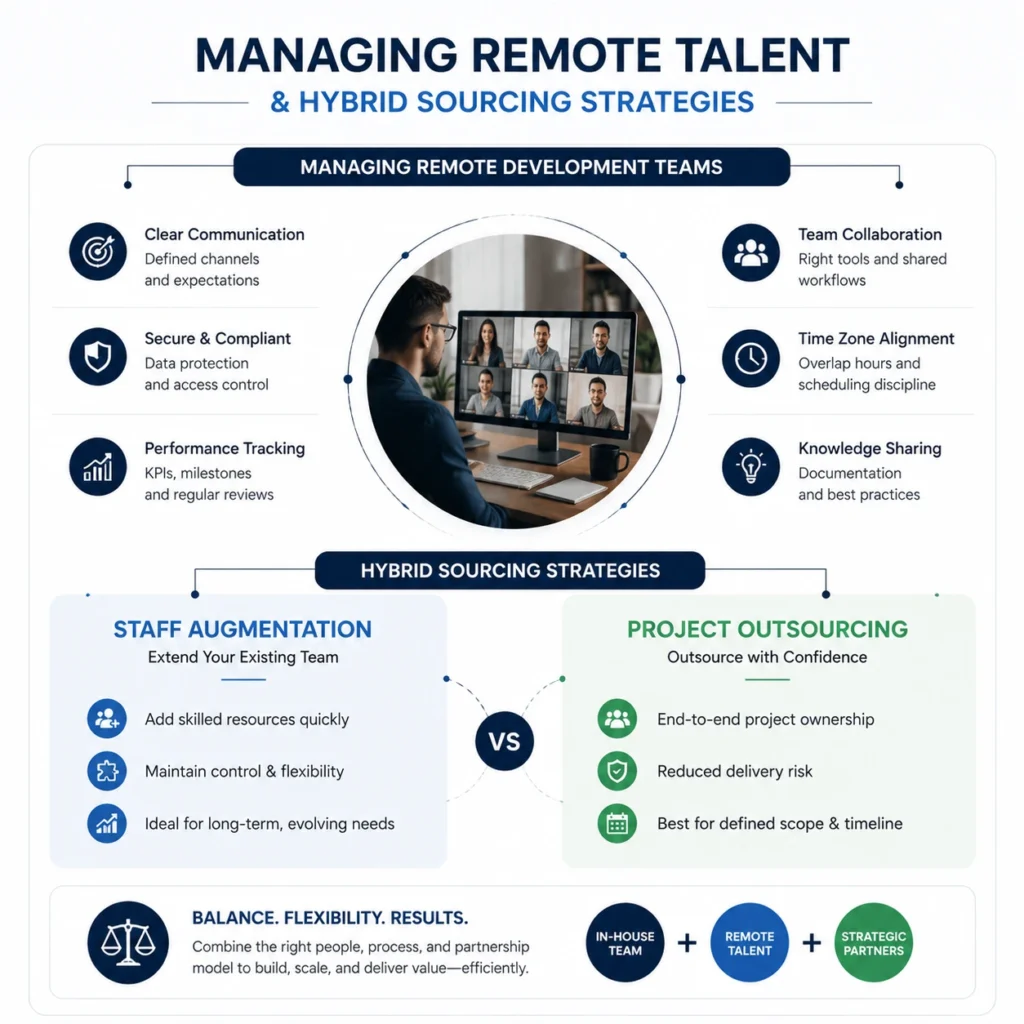
Managing software production remotely requires structured communication frameworks and automated tracking rather than passive reliance on trust. Disorganized remote workflows lead to bloated timelines, misaligned specs, and code conflicts.
Establishing Protocols for Managing Remote Software Development Teams
Managing remote engineering teams effectively relies on strict daily asynchronous standups, clear Jira task tracking, and mandatory daily code commits. Without structured communication channels, remote teams suffer from scope creep, misaligned sprint priorities, and slow pull request reviews. Establishing clear guidelines around core overlap hours, sprint demos, and automated testing prevents communication friction across time zones.
Balancing Staff Augmentation vs Project Outsourcing Frameworks
Staff augmentation plugs specific technical skill gaps in your existing team, while project outsourcing hands complete operational accountability to an external partner. If you already have an active CTO and internal tech lead who simply need two extra React Native or Flutter developers to hit a deadline, staff augmentation is the right move. If you lack internal technical leadership and need a complete product built from raw requirements to app store deployment, project outsourcing is far safer.
Intellectual Property Control and Capacity Expansion
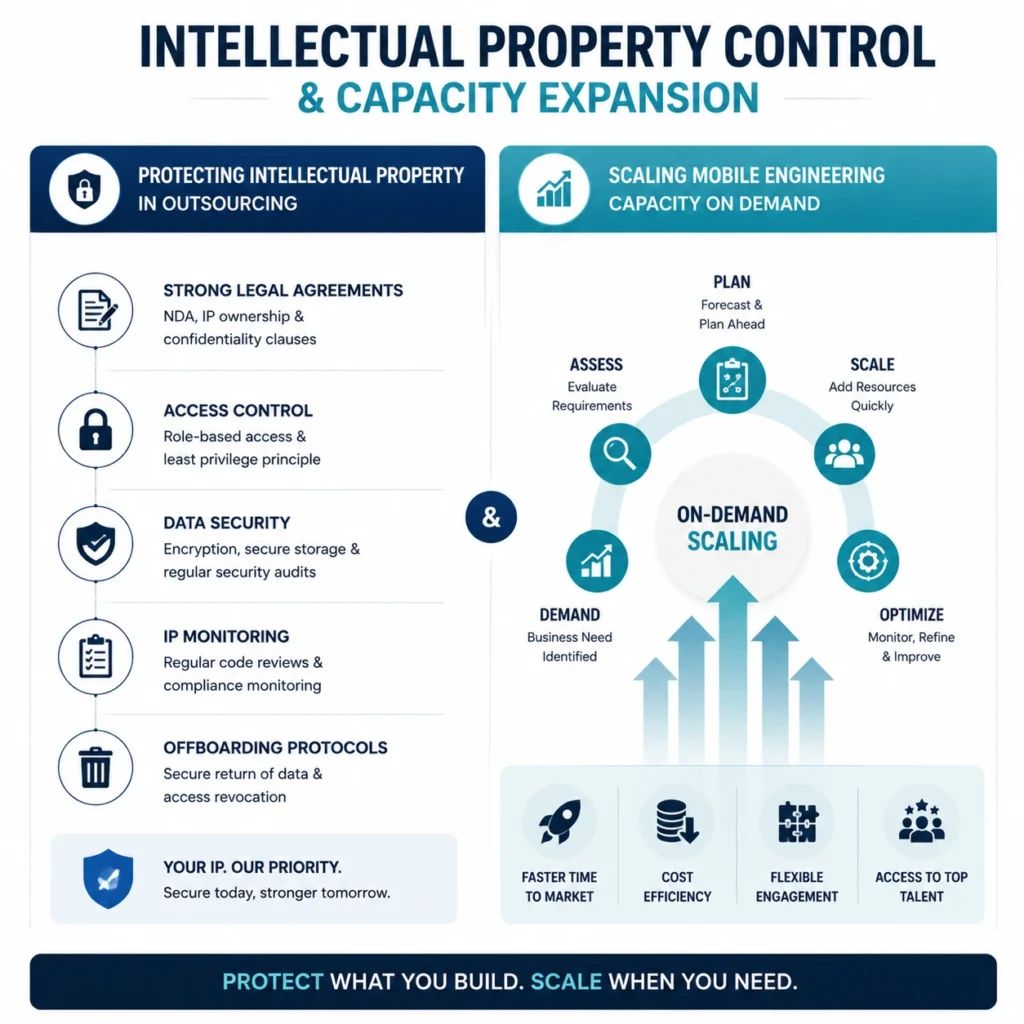
Protecting your underlying software architecture and maintaining the ability to scale up or down on demand are critical for long-term valuation. Sloppy contracts can tie up your source code in legal battles, while rigid team structures prevent rapid pivots.
Enforcing Protocols for Protecting Intellectual Property in Outsourcing
Securing your digital IP requires enforceable non-disclosure agreements, clear “work-for-hire” contractual clauses, and strict database access controls. You must confirm your contract explicitly states that one hundred percent of the source code, design assets, and database schemas belong exclusively to your company upon payment. Additionally, external teams should work inside your company’s controlled GitHub or GitLab repositories rather than hosting code on their private servers.
Executing Tactics for Scaling Mobile Engineering Capacity On Demand
Scaling engineering capacity on demand requires using flexible agency resources to handle temporary development spikes without taking on permanent salary obligations. During heavy initial build phases or major platform redesigns, you may need six developers working simultaneously to meet tight deadlines. Once the major update is live, an agency model allows you to scale back to a lean two-person maintenance unit within days, preserving cash reserves.
Market metrics from international software outsourcing indexes show that companies utilizing flexible agency models cut their annual engineering operational overhead by nearly 50% compared to those relying exclusively on full-time internal teams. This financial flexibility allows fast-growing startups to direct critical capital toward user acquisition and product marketing.
Why Hire for Months When You Can Build Today?
If you want to spend six months interviewing software developers while your burn rate drains your runway, build an in-house team. But if you want to ship high-performance code right now, FlowmazeUX is your engineering partner. We eliminate recruitment delays, cut massive HR overhead, and deploy cross-functional teams that build clean, secure software using Flutter, Swift, and Kotlin.
You keep 100% control of your IP, have full visibility to repositories and deliver scalable software without permanent payroll liabilities. Learn more about our custom mobile app development services from strategy to UI/UX design, engineering, testing, deployment and ongoing product support at FlowmazeUX. Stop wasting time recruiting; develop your product today
Frequently Ask Questions
Maintaining an internal team requires covering base salaries, healthcare benefits, recruitment fees, equipment, and paid leave, which easily exceeds $400,000 per year for a basic team. Outsourcing transforms these fixed personnel expenses into variable project costs, reducing overall expenditure by forty to sixty percent while avoiding long-term payroll commitments.
The biggest advantages are rapid deployment, access to senior specialized talent, and reduced financial overhead. The primary drawback is potential communication misalignment if you choose an unvetted vendor that lacks structured agile workflows or daily code repository access.
Building an internal team requires 45 to 90 days just to recruit, vet, and onboard developers before coding even begins. An established agency already has fully integrated teams ready to write production code within two weeks, cutting your time to market by months.
Overlooked costs include recruitment agency placement fees, sign-on bonuses, corporate tax liabilities, health insurance, expensive hardware, software licenses, and the massive cost of lost productivity during employee turnover.
Project outsourcing is ideal for startups lacking internal technical leadership because the agency takes full responsibility for building the product from scratch. Staff augmentation is better when you already have a technical founder or CTO who simply needs extra developers to increase coding throughput.
You must execute strict non-disclosure agreements and include explicit "work-for-hire" clauses transferring complete code ownership to your firm upon payment. Always require external developers to commit code directly into your organization's secure GitHub or GitLab repository.
An agency allows you to adjust team size up or down based on your active development needs within days. Expanding or downsizing an in-house team requires lengthy recruitment cycles or painful corporate layoffs that damage company culture.
A balanced team requires a senior systems architect, dedicated native or cross-platform developers, a UI/UX designer, a QA automation engineer, and an agile project manager. Relying on a single internal "full-stack" developer creates single-point-of-failure risks and usually leads to messy, unmaintainable code.