Users don’t complain; they leave. And that’s where frontend engineering quietly decides your revenue. You can pour money into ads, funnels, and branding. But if your frontend doesn’t deliver, you’re leaking conversions every second. Businesses invest heavily in visuals but underestimate what happens after the page loads: that’s where real ROI is either made or lost.
Here’s the uncomfortable truth: most products don’t fail because of bad ideas. They fail because the experience feels off.
A button lags.
A page loads slowly.
Something breaks on mobile.
Speed Isn’t a Feature. It’s Revenue.

Google found that when page load time increases from 1 second to 3 seconds, the probability of bounce increases by 32%. Push that to 5 seconds, and you’re looking at a 90% bounce rate spike.
That’s not a UX issue. That’s lost money. This is where frontend performance optimization stops being technical and starts being financial. Great frontend engineering ensures:
- Faster load times
- Smooth interactions
- Zero friction between user intent and action
And yes, it starts with the basics (HTML, CSS, JavaScript), but what separates average from elite is how these are structured, optimized, and delivered .Most teams stop at “it works.” Winning teams obsess over “it feels instant.”
Pretty UI Without Engineering = Expensive Decoration
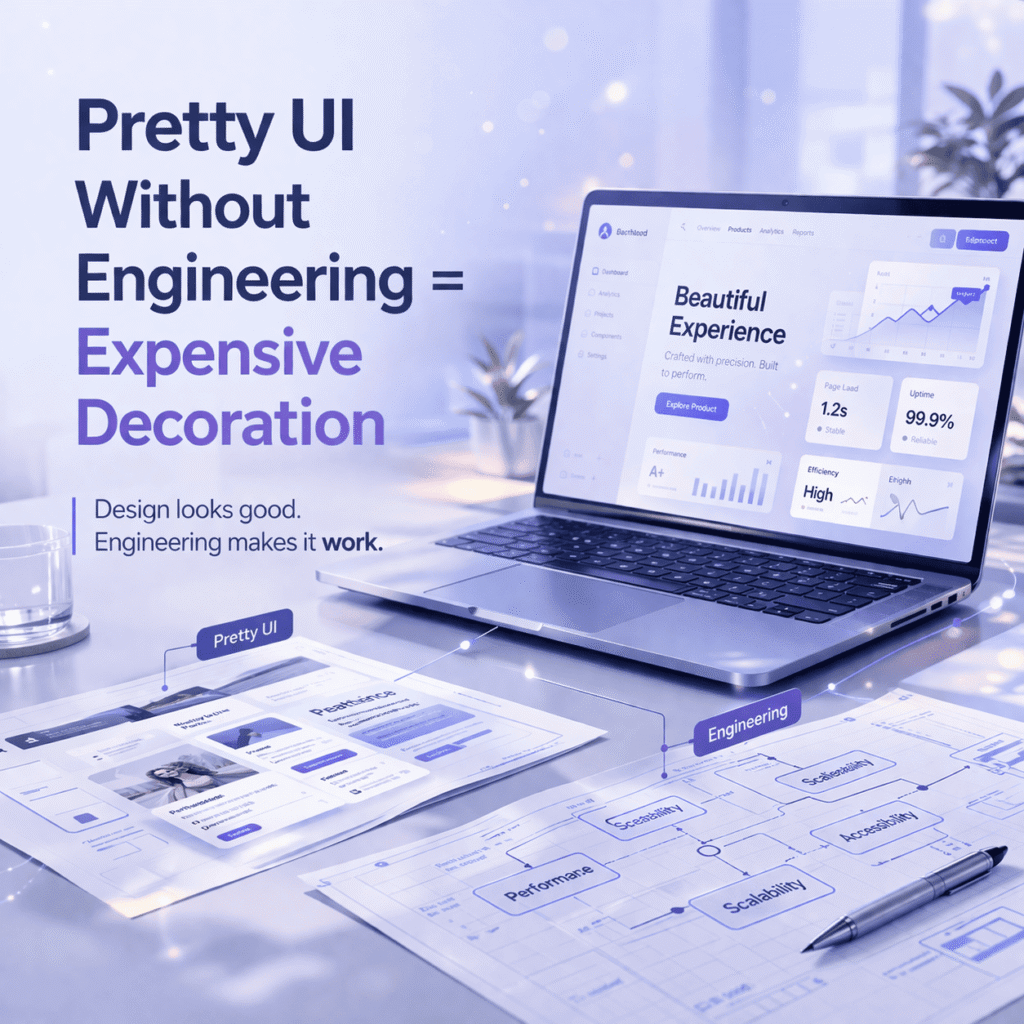
Design gets attention, and engineering keeps it. You can have stunning visuals, but without strong UI frontend development, it’s just decoration. The real job is turning design into something that behaves perfectly across devices, loads fast, and responds instantly. This is where responsive frontend design becomes critical. Over 60% of global web traffic now comes from mobile devices.
If your interface breaks, shifts, or slows down on smaller screens, you’re not just annoying users; you’re losing them. And here’s the catch: “Responsive” doesn’t just mean it fits the screen. It means:
- It feels native on every device
- It adapts to behavior, not just layout
- It removes friction completely
That’s the difference between design and real frontend engineering.
If It Breaks on Safari, You’re Already Losing Customers

Here’s something most businesses ignore until it’s too late: Your product doesn’t live in one browser. Chrome, Safari, Firefox, Edge: each behaves differently. Without proper cross-browser frontend engineering, your “perfect” product turns inconsistent. A feature works in one place, breaks in another, and suddenly your user experience is unpredictable. That’s why frontend testing QA isn’t optional but survival. Testing ensures:
- Features behave consistently
- Layouts don’t break randomly
- Performance stays stable across environments
Frontend Isn’t Design. It’s Psychology in Code

Think about this stat: 58% of consumers discover new businesses through social media. That means your first impression isn’t your brand; it’s your experience. And that experience is controlled by the frontend. Every scroll, click, delay, and animation shapes perception:
- Fast = trustworthy
- Smooth = premium
- Broken = risky
This is where frontend architecture best practices come into play. Good architecture ensures:
- Scalability as your product grows
- Maintainability for future updates
- Clean performance under pressure
Bad architecture? It slows everything down: development, performance, and growth.
Why “Responsive” Doesn’t Mean What You Think Anymore

Let’s break a myth. Most teams think responsive frontend design is about adjusting layouts. Wrong! In 2026, it means:
- Adapting to user behavior
- Optimizing for speed on low bandwidth
- Prioritizing content dynamically
And this is where modern frontend frameworks like React, Vue, and Next.js dominate. They don’t just render interfaces. They manage state, performance, and user experience at scale. If you’re still relying on outdated approaches, you’re not just behind, you’re inefficient.
The Silent Killer: Poor Frontend Architecture

Most performance issues don’t come from bad code. They come from a bad structure. Without strong frontend architecture best practices, you’ll face:
- Slower feature releases
- Increasing bugs
- Performance bottlenecks
And eventually… technical debt that kills momentum. Smart teams build systems, not pages. They use:
- Component-based structures
- Scalable design systems
- Efficient state management
This is where frontend engineering becomes a long-term investment, not just a development phase.
You Don’t Need More Traffic. You Need Better Frontend

Here’s a brutal reality check. Most businesses don’t have a traffic problem. They have a conversion problem. You can double your ad spend, but if your frontend is slow, clunky, or inconsistent, you’re just paying more to lose more. This is why companies invest in frontend development services. Not for visuals, but for performance, scalability, and results. And it doesn’t stop there; true ROI comes when:
- frontend backend integration are seamless
- APIs respond fast
- Data flows without delay
Tools Don’t Save You – Execution Does

Yes, tools matter. HTML, CSS, and JavaScript are still the foundation. Modern frontend frameworks accelerate development. Testing tools improve stability. But tools don’t create results – execution does. A skilled engineer knows:
- When to optimize
- What to prioritize
- How to balance performance with experience
That’s what separates average frontend development services from elite ones.
The Real ROI No One Talks About

The social media management market alone is projected to reach $164.52 billion by 2034, driven heavily by digital experiences and performance expectations. Let’s connect the dots. Good frontend engineering delivers:
- Faster load times → lower bounce rates
- Better UX → higher engagement
- Smooth performance → increased conversions
- Reliable systems → long-term scalability
Every digital touchpoint is becoming more competitive. And frontend? It’s where that competition is won or lost.
Your Product Isn’t Competing on Features Anymore
It’s competing on experience. Users don’t compare specs. They compare how things feel. So the real question isn’t: “Do we have a good product?” It’s: “Does it feel fast, smooth, and effortless?”Because in 2026, frontend engineering isn’t a layer. It’s the difference between growth and stagnation.