Table of Content
- Introduction
- Get the Facts: Why Most Apps Die (And How the Best Stay Alive)
- UI vs UX in Mobile App Development: What Is the Difference?
- In-House vs Agency: Which is Better for Mobile App Design?
- How to Choose the Best UI/UX Design Agency for Mobile Apps?
- Top Qualities of a Great UI/UX Design Agency (The Traits Nobody Mentions)
- The UI/UX Design Process for Mobile App Development
- How Much Does a UI/UX Design Agency Charge for Mobile Apps?
- Benefits of Hiring a UI/UX Design Agency for Mobile Apps
- UI/UX Design Trends in Mobile App Development (2026)
- Common UI/UX Mistakes in Mobile Apps (And How to Avoid Them)
- Case Study: How UI/UX Design Improved Mobile App Performance
- The “Safe” Choice is Your Greatest Risk
- Why FlowmazeUX is the Only Logical Destination for Your Product
Introduction
Most founders think they have a development problem when, in reality, they have an experience problem. You can hire the best developers in the world to write flawless code, but if your interface feels like a chore, users will delete you faster than a spam text.
In 2026, the best UI/UX design agency for mobile app development isn’t the one that wins design awards but the one that wins back your customer’s time. Moreover, we aren’t here to talk about “user-friendliness” in vague terms. We are here to talk about ROI. Plus, we are here to talk about why 95% of apps are abandoned within 30 days and how the top 5% use user experience analysis to stay indispensable. This is your master guide to navigating the design landscape without burning your budget on vanity.
Get the Facts: Why Most Apps Die (And How the Best Stay Alive)
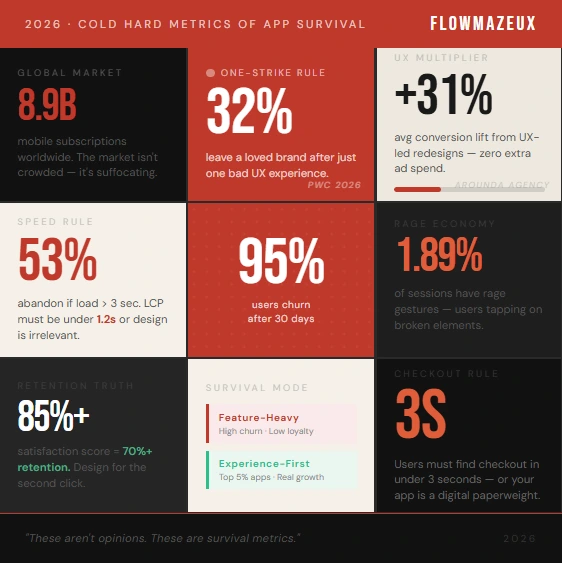
Let’s be super honest: the world doesn’t need another “okay” mobile app. With over 8.9 billion mobile subscriptions globally in 2026, the marketplace isn’t just crowded; it is suffocating. The reality is that a website UX audit or an app evaluation often reveals that “pretty” design is actually killing your business. If your UI looks like a Dribbble shot but your users can’t find the checkout button in under three seconds, you haven’t built a product; you’ve built a digital paperweight.
Before you spend a single dollar on a UI/UX design agency, you need to understand the data-driven reality of the 2026 mobile economy. These aren’t opinions; these are the cold, hard metrics of survival.
The “One-Strike” Rule is Real
PwC’s 2026 research confirms that 32% of customers will walk away from a brand they love after just one bad experience. If your app crashes, lags, or confuses a user on their first session, you don’t get a second chance. You are effectively paying for ads just to hand your customers over to your competitors.
UX is the Ultimate Multiplier
Recent data from Arounda Agency shows that UX-led redesigns drive an average +31% increase in conversion rates. That is the difference between a struggling startup and a scaling empire, achieved without increasing your ad spend by a penny.
Speed is a Functional Requirement, Not a Bonus
Today’s users are chemically incapable of waiting. 53% of users will abandon a search or an app interaction if it takes more than three seconds to load. In 2026, if your mobile UX evaluation doesn’t prioritize “Largest Contentful Paint” (LCP) under 1.2 seconds, your design is irrelevant.
The “Rage Tap” Economy
Roughly 1.89% of all mobile sessions in 2026 contain “rage gestures”, users frantically tapping on elements that don’t respond. Agencies that ignore website behavior analytics are essentially building obstacles, not interfaces.
Retention is the Only Metric That Works
95% of users churn after 30 days. The apps that survive are those that move from “Feature-Heavy” to “Experience-First.” In 2026, user satisfaction scores of 85%+ correlate directly with 70%+ retention rates. So, If you aren’t designing for the “second click,” you are just renting users, not owning them.
UI vs UX in Mobile App Development: What Is the Difference?
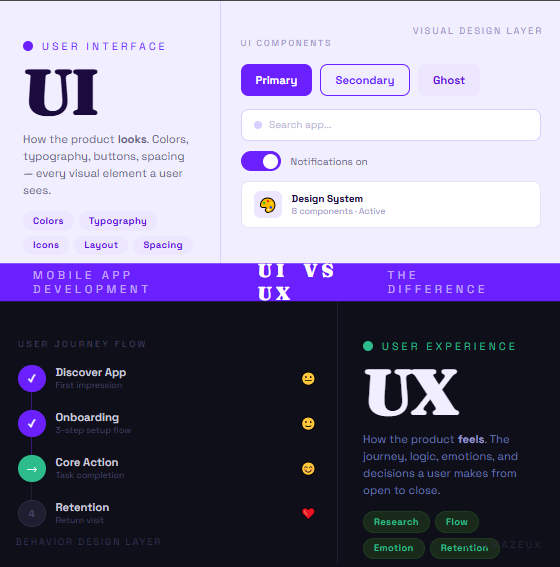
This is the most common point of confusion for founders, and getting it wrong is expensive. If you hire a UI designer when you need a UX strategist, you will end up with a beautiful app that nobody knows how to use. If you hire a UX researcher without a strong UI partner, you will have a logical app that looks like it was built in 1998. You need both, but you must understand their distinct roles. For a deeper dive: see our UI vs UX in Mobile App Development: What’s the Difference? guide.
UX (User Experience): The “Logic” and the “Skeleton”
UX is about the feel: does this solve my problem? Does it save me time? It is the invisible scaffolding that ensures the app is functional and intuitive.
Secondly, the UX is the structural integrity of your app. It is the research, the user journey mapping, and the wireframes. If the user feels frustrated because they can not find the “Logout” button, that is a UX failure.
UI (User Interface): The “Senses” and the “Skin”
The UI is the visual and interactive layer. It is the typography, the color palette, and the “Bento Grid” layouts of 2026.
UI is about the look: does this brand feel trustworthy? Is the text readable in direct sunlight? While UX makes the app usable, UI makes it desirable. A great agency understands that UI is the “hook” that earns the user’s initial trust, while UX is the “substance” that keeps them coming back.
In-House vs Agency: Which is Better for Mobile App Design?
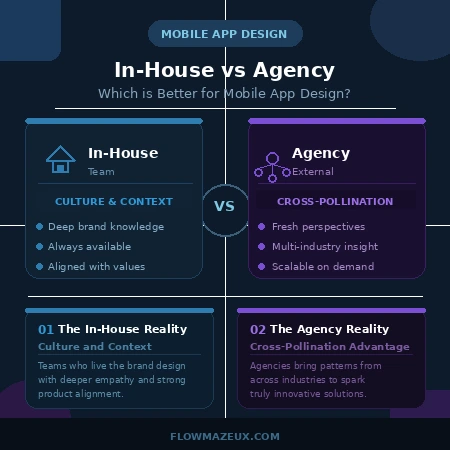
This is the debate that keeps CFOs awake at night. The truth is that there is no “correct” answer, only a “correct for right now” answer. Choosing between building an internal team and hiring an agency is a choice between fixed overhead and variable expertise. You must decide if you want to manage people or if you want to manage results. For a deeper comparison of operational costs, scalability, and product velocity, read our guide on In-House vs Agency: Which is Better for Mobile App Design?.
The In-House Reality: Culture and Context
Building an in-house team is great for long-term consistency. Your designers live and breathe your product every single day. However, the reality is that in-house teams often become “product blind.” They get used to the flaws, they stop challenging the status quo, and they can become a massive fixed cost that is hard to scale back if the market shifts.
The Agency Reality: The “Cross-Pollination” Advantage
Hiring the best UI/UX design agency for mobile app development gives you access to “Aggregated Intelligence.” Agencies work across multiple industries, meaning they can take a winning strategy from a Fintech app and apply the psychology to your Healthcare app. You are paying for a team that is already at the top of their game, with no training period required and the flexibility to scale up or down based on your roadmap.
How to Choose the Best UI/UX Design Agency for Mobile Apps?
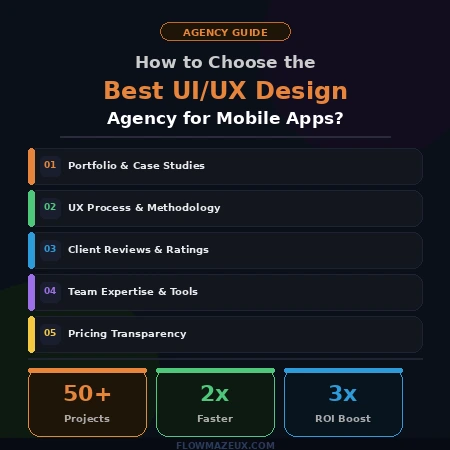
Choosing an agency is less about finding a “service provider” and more about selecting a high-stakes partner for your product’s future. Founders make the mistake of choosing based on the “visual high” of a flashy portfolio. But a screenshot doesn’t tell you if the app actually generated revenue, or if the users abandoned it because the navigation felt like a maze.
What Is The Industry Secret?
If you are still considering your options for finding partners, refer to our comprehensive guide to selecting the right UI/UX design agency for mobile applications. Learn about the processes, warning signs, and approaches employed by successful entrepreneurs in 2026.
The best agencies spend more time dissecting your business goals than your brand colors. If an agency promises a “premium look” before they ask about your current drop-off rate or your target LTV (Lifetime Value), they are just selling wallpaper. You aren’t hiring an artist; you’re hiring a digital architect who understands that every pixel must earn its keep.
To find the elite 1%, look for Operational Transparency. Ask them to walk you through a project that didn’t go as planned. If they claim every launch was a flawless victory, they’re hiding the truth. The best agencies show you the “pivot moments”, the wireframes they scrapped because user testing proved the concept was flawed. If they can’t explain the cognitive psychology behind a button’s placement, they are just pushing pixels and hoping for the best.
Top Qualities of a Great UI/UX Design Agency (The Traits Nobody Mentions)
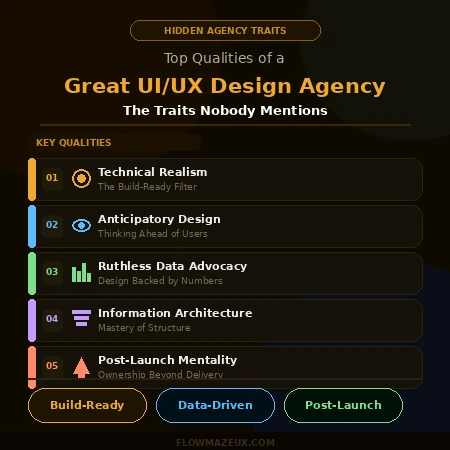
Forget creativity, that’s the bare minimum. If you want an app that actually survives the 2026 market, you need an agency that possesses these specific, often-ignored lethal qualities. If you’re comparing partners, review these 12 Top Qualities of the Great UI/UX Design Agency (2026) before making a costly decision.
Technical Realism (The “Build-Ready” Filter)
There is nothing more expensive than a design agency that doesn’t understand code. They’ll sell you a dream filled with 3D elements and heavy animations that will make your app crawl. A great agency has “Developer Empathy,” ensuring the mobile UX evaluation results in a high-performance reality, not an unbuildable Figma file.
Anticipatory Design Thinking
The best agencies understand the art of removing choices before the user even has to ask. If the agency talks about “reducing cognitive load” by automating the boring parts of the user journey, you’ve found a partner that values your users’ time as much as you do.
Ruthless Data Advocacy
A mediocre agency follows your orders; a great agency protects your ROI. If you have an idea that conflicts with website behavior analytics, they will tell you. They are advocates for the user, ensuring that the founder ego never gets in the way of a conversion-optimized interface.
Information Architecture Mastery
Most agencies focus on the “skin,” but the elite focus on the “skeleton.” They understand that if the information hierarchy is a mess, no amount of pretty buttons will save the app. They map out the user journey so intuitively that the user never has to “think” about what to do next; the app simply feels like an extension of their own intent.
The “Post-Launch” Mentality
A top-tier agency doesn’t disappear the moment the app hits the store. They treat the launch as “Day One” of the real test. They prioritize iterative design, looking at real-world data to refine the UX. They understand that a product is never “finished”. It is either evolving or it is dying.
The UI/UX Design Process for Mobile App Development
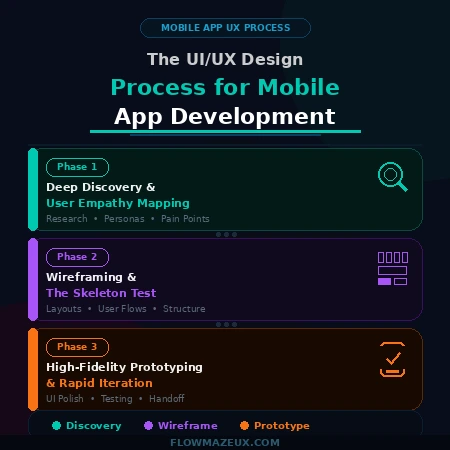
Most CEOs of companies think the design process is a straight line from a sketch to the App Store. It isn’t. If your agency treats it like a “one-and-done” creative sprint, they are essentially guessing with your capital. A high-performance UI/UX design process is a recursive loop of validation, where “looking good” is secondary to “working flawlessly.” It’s about building a digital ecosystem that survives the real world.
To understand how this actually works step-by-step, explore our detailed breakdown of the UI/UX design process for mobile app development.
Phase 1: Deep Discovery and User Empathy Mapping
Before a single pixel is moved, the elite agencies dive into the “Why.” This isn’t about colors; it’s about identifying the friction points your competitors missed. By using user experience analysis, they map out the emotional highs and lows of your target audience. They aren’t just designing screens; they are solving a specific human frustration.
Phase 2: Wireframing and the “Skeleton” Test
This is where the “spicy” truth comes out: if your app doesn’t work in black and white with basic boxes, no amount of $2026$ aesthetic trends will save it. Wireframing is the stress test for your information architecture. It ensures the mobile UX evaluation focuses on logic and flow before the “visual high” of the final UI distracts the stakeholders.
Phase 3: High-Fidelity Prototyping and Rapid Iteration
In this stage, the “skeleton” gets its “skin.” But a static image is a lie. The best agencies deliver interactive prototypes that mimic the final product. This allows for real-world website usability testing before the expensive development phase begins. It’s about failing fast and fixing early so you don’t pay for the same mistake twice during the build.
How Much Does a UI/UX Design Agency Charge for Mobile Apps?
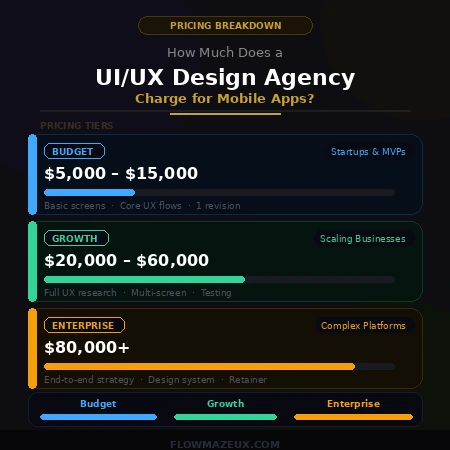
Let’s stop pretending there is a “standard price”. Meaning, you aren’t paying for hours; you are paying for the elimination of risk. If an agency quotes you $500 for a full mobile app, they aren’t giving you a deal; they are giving you a template that will likely cost you thousands in lost conversions later.
If you want a complete breakdown of pricing structures, hidden costs, and what agencies actually charge, read our detailed guide on How Much Does a UI/UX Design Agency Charge for Mobile Apps?
The “Budget” Tier: $5,000 to $15,000
This is usually the realm of boutique agencies or high-end freelance collectives. You get the essentials: a solid heuristic UX review, clean UI, and basic wireframes. It’s perfect for an MVP (Minimum Viable Product) where you need to prove the concept without selling the house. However, don’t expect deep website behavior analytics or custom motion design at this level.
The “Growth” Tier: $20,000 to $60,000
This is where the best UI/UX design agency for mobile app development truly operates. At this price point, you are buying a dedicated team of specialists: researchers, UX writers, and interaction designers. You are paying for deep competitive research and multi-round user testing.
The “Enterprise” Tier: $80,000+
When the cost of failure is in the millions, you go to Enterprise. This covers global accessibility standards, complex multi-platform ecosystems, and ongoing UX audit services. You aren’t just buying a design; you are buying a long-term strategic partnership that treats your app’s performance as a mission-critical metric.
Benefits of Hiring a UI/UX Design Agency for Mobile Apps
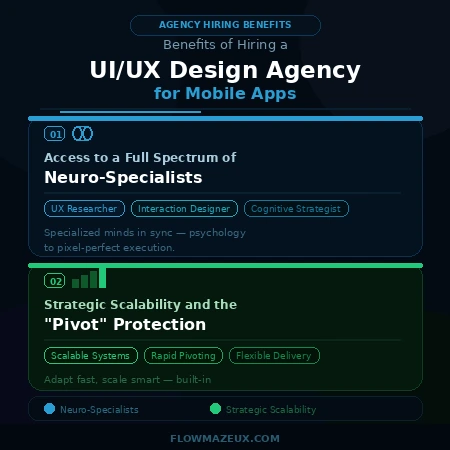
The app store is full of beautifully designed apps that nobody uses because they were built in a vacuum. A specialized agency brings a “battle-tested” perspective that a single freelancer or a distracted founder simply can’t replicate.
Access to a Full Spectrum of Neuro-Specialists
A premium agency doesn’t just give you a “designer.” They give you an ecosystem. This includes a UX researcher who uncovers why your users are frustrated, a UI designer who masters the visual language, and an interaction specialist who ensures every swipe feels like a dopamine hit. In 2026, user experience analysis requires too many disciplines for one person to master. Hiring an agency means you’re buying a collective brain.
Apart from the obvious benefits, many companies fail to realize the other aspects that an agency can add to their operations. Get insights about the benefits of working with a UI/UX design agency for your mobile app in our article on what to expect from a smart UX design strategy.
Strategic Scalability and the “Pivot” Protection
Startups fail because they can’t move fast enough when the data says “stop.” An agency provides the infrastructure to pivot your entire interface in weeks, not months. They handle the mobile UX evaluation in real-time, allowing you to scale your features without breaking the existing user journey. Remember. you aren’t just paying for the launch; you’re paying for the ability to survive the first six months of user feedback.
UI/UX Design Trends in Mobile App Development (2026)
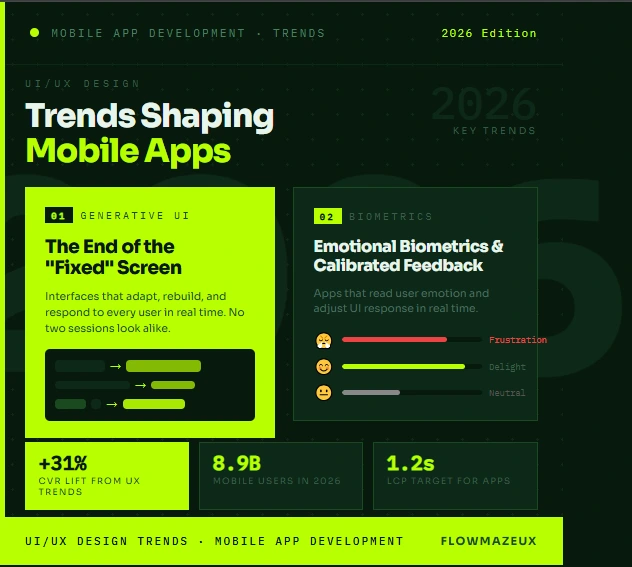
We have moved past the era of “user-initiated” actions. Your users are tired of clicking buttons. The best apps today are those that predict what the user wants before they even touch the screen. If your design isn’t leaning into “Sentient Interfaces,” you are already designing for the past.
Generative UI: The End of the “Fixed” Screen
In 2026, the best apps don’t look the same for every user. Generative UI uses AI to rebuild the interface on the fly based on individual behavior, cognitive load, and even the time of day. If a user is in a “hurry” (detected by rapid, imprecise taps), the UI simplifies itself, enlarging the primary CTA and hiding secondary noise. It’s no longer about a “perfect layout”; it’s about a “perfectly adaptive” one.
Emotional Biometrics and Calibrated Feedback
Design is becoming “emotional.” Modern apps are beginning to use biometric data, heart rate from a watch or subtle facial cues to adjust the user experience analysis in real-time. A meditation app might dim its colors and slow down its animations if it detects high stress. This isn’t science fiction; it is the 2026 standard for high-retention products. If your app feels “cold” and static, your users will find one that feels “alive.”
To discover other future-driven innovations impacting the current world of mobility, check out our full guide on innovative UI/UX design trends for mobile app development in 2026.
Common UI/UX Mistakes in Mobile Apps (And How to Avoid Them)

Most app failures are not caused by bad code. They are caused by “Design Ego.” This happens when a founder or a designer prioritizes a creative vision over the actual cognitive behavior of a human being. Hence, users do not have the patience to learn your unique way of doing things. If you force them to think, you have already lost them. These problems are addressed in our guide to common UI/UX mistakes in mobile applications for 2026.
The Complexity Overload and the “Feature Soup”
The biggest mistake is the belief that more features equals more value. It actually creates “Analysis Paralysis.” When you cram every possible function into the navigation bar, the user feels overwhelmed and shuts down. The fix is a ruthless website UX audit mindset: if a feature does not serve the primary goal of the current screen, it should be hidden or removed.
Ignoring the “Thumb Zone” in Mobile Ergonomics
It is shocking how many apps place critical buttons at the very top of the screen. As phone screens get larger, the “reachability” factor becomes a major friction point. If your user has to use two hands to click “Confirm,” your mobile UX evaluation has failed. You must design for the natural arc of a thumb, Thumb zone optimization is one of the most underestimated principles discussed in this 2026 guide on UI/UX mistakes in mobile applications. keeping primary actions in the bottom third of the device.
Case Study: How UI/UX Design Improved Mobile App Performance
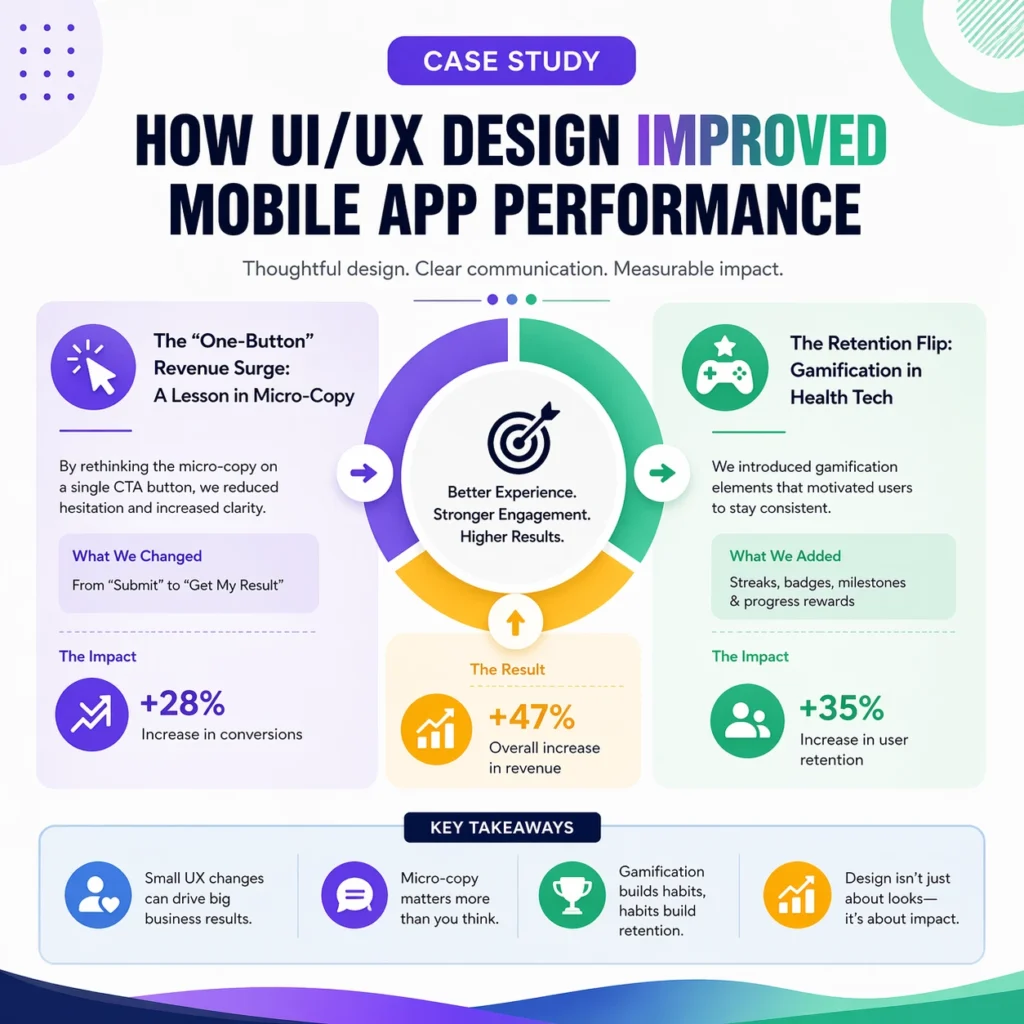
If you want to see the true power of the best UI/UX design agency for mobile app development, look at the “hidden” success stories of 2026. These are not just about “rebranding.” They are about identifying a specific psychological friction point and removing it with surgical precision. When a product is struggling, the answer is rarely “more features.” It is almost always “less friction.” For an in-depth exploration, see our case study: How UI/UX Design Improved Mobile App Performance, which goes into the actual tactics that led to demonstrable results.
The “One-Button” Revenue Surge: A Lesson in Micro-Copy
A major global retailer realized that their mobile app was seeing a 65% drop-off at the final checkout screen. They did not change the price. They did not change the product. They simply changed the “Register” button to a “Continue as Guest” option. This single user experience analysis adjustment led to a $300 million increase in annual revenue. The lesson? Your design is either an open door or a locked gate.
The Retention Flip: Gamification in Health Tech
A struggling fitness app was seeing a 90% churn rate after the first week. An agency audit found that users felt “overwhelmed” by the data tracking. By introducing gamified progress visuals and “micro-interactions”, subtle haptic feedback and celebratory animations for small wins, the app increased its 30-day retention by 70%. They moved the focus from “labor” to “reward,” proving that design is the ultimate driver of human behavior.
The “Safe” Choice is Your Greatest Risk

Most entrepreneurs will still choose the “safe” agency: the one with the largest office and the most generic “user-first” slogans. In twelve months, those same founders will be back at the starting line, wondering why their retention is in the basement and why their “premium” design feels like a hollow shell.
The “safe” choice in 2026 is a final destination. In an era of Generative UI and Anticipatory Design, being “good enough” is just a slow way to go out of business. If your agency is not challenging your assumptions and obsessing over website behavior analytics, they are an anchor, not an asset.
Why FlowmazeUX is the Only Logical Destination for Your Product
If you want an agency to simply say “yes” to every whim, do not call us. There are plenty of pixel-pushers who will happily drain your budget to build a mistake. At FlowmazeUX, business of performance comes first, not people-pleasing. We Recognized as a best UI/UX design agency for mobile app development because we treat your ROI as our primary KPI.
Our “Surgical Audit” philosophy finds the “leaks” that your developers missed and your previous designers ignored. When you partner with us, you gain a team that lives at the intersection of psychology and technology. Every interface is engineered to meet the 2026 demands. The goal isn’t just to launch; we help you own the market.
Frequently Ask Questions
An agency that prioritizes "vibes" and aesthetics over your app growth metrics. If they don't ask about your conversion goals and user pain points immediately, they are artists, not strategic partners.
No. Size is a vanity metric. True value lies in Design ROI analysis and direct access to senior strategists who move the needle, rather than paying for a bloated layer of account managers.
Because pixels without a predictive UX strategy are a waste of capital. Investing 40% of the timeline in research ensures the final design is optimized for retention before a single line of code is written.
You are paying for the expertise that prevents six-figure development mistakes. Premium agencies provide a scalable mobile design system and motion logic, whereas cheap alternatives deliver flat files that fall apart during build.
Yes. Conversion-focused UX proves to investors that your product is a low-risk, high-performance asset. A psychologically-backed roadmap is far more persuasive than a simple "pretty" prototype.
Only if they serve the user. In 2026, the real trend is AI interface design: UI that adapts to behavior. Visual fads date quickly; functional, adaptive logic stays relevant and profitable.
High cognitive load. If a user has to think for more than two seconds about their next move, they will abandon the app. Retention-driven design focuses on simplifying the path to value.
Use an agency for "zero-to-one" innovation and to build your foundational mobile design system. Agencies offer cross-industry stress-testing that in-house teams, who are often too close to the product, simply cannot match.